
ScanEagle Unmanned Technology Benefits Natural Gas BVLOS Operations | Aero-News Network
Aero-News Network
RSS icon RSS feed
podcast icon MP3 podcast
Subscribe Aero-News e-mail Newsletter Subscribe

Airborne Unlimited -- Most Recent Daily Episodes

Episode Date

Airborne-Monday

Airborne-Tuesday

Airborne-Wednesday Airborne-Thursday

Airborne-Friday

Airborne On YouTube

Airborne-Unlimited-12.01.25

AirborneNextGen-
12.02.25

Airborne-Unlimited-12.03.25

Airborne-FltTraining-12.04.25

AirborneUnlimited-12.05.25

AFE 2025 LIVE MOSAIC Town Hall (Archived): www.airborne-live.net

Fri, May 06, 2016

ScanEagle Unmanned Technology Benefits Natural Gas BVLOS Operations

Will Fly For Queensland Gas Company To Inspect Wells, Pipelines, Other Facilities

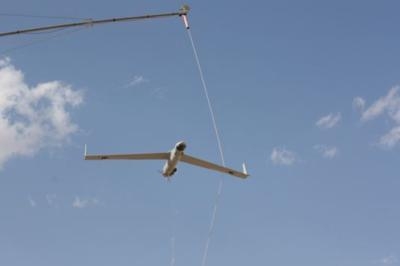
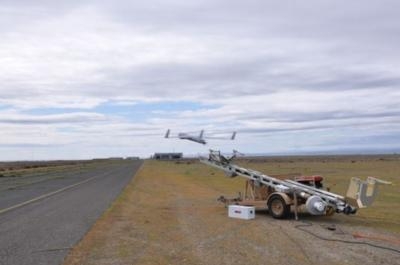
After 18 months of successful trials, natural gas company Queensland Gas Company (QGC), a Shell-owned business, is introducing the ScanEagle Remotely Piloted Aircraft System (RPAS) to inspect gas wells, pipelines and processing facilities.

Insitu Pacific Managing Director Andrew Duggan said the unmanned Beyond Visual Line of Sight (BVLOS) operations had never before been used commercially on this scale.

"By working closely together and with Australia's Civil Aviation Safety Authority, the ScanEagle is helping QGC to begin streamlining its inspections, with benefits for both the local resources and agriculture sectors," said Mr. Duggan. "We're very proud of this effort by Insitu Pacific and QGC."

QGC is starting to conduct BVLOS operations in the Surat Basin of south-west Queensland on inspection and monitoring tasks for up to eight hours per day. Until now all inspections have been conducted by operations staff on the ground or by piloted aircraft.

Shell Australia Country Chair Andrew Smith said the RPAS operations were an example of collaboration across industry service providers.

"This innovative solution will improve safety by reducing the need for driving and use of helicopters and fixed-wing aircraft," Mr Smith said.

"Over time and as we progressively introduce this technology, it will reduce inconvenience to landowners by cutting the number of land access requests, and the cost to QGC, associated with regular on-the-ground visual inspections."

The ScanEagle RPAS is being launched and recovered from QGC property and operated by Insitu Pacific personnel.

The ScanEagle RPAS has a 3m wingspan and operates between 1,500-3,000ft, in compliance with the Civil Aviation Safety Authority (CASA) air safety regulations.

QGC is actively engaging landholders regarding the introduction of the new RPAS technology to ensure the community remains informed.

(Images provided with Insitu Pacific news release)

FMI: www.insitupacific.com

Advertisement

More News

Classic Aero-TV: VerdeGo Debuts VH-3 Hybrid-Electric Powerplant

From 2023 (YouTube Edition): New Propulsion Scheme Optimized for AAM Applications Founded in 2017 by Eric Bartsch, Pat Anderson, and Erik Lindbergh (grandson of famed aviation pion>[...]

NTSB Prelim: Grumman American Avn. Corp. AA-5B

During The Initial Climb, The Engine Began To Operate Abnormally And, After About Three Seconds, Experienced A Total Loss Of Power On October 29, 2025, about 1820 Pacific daylight >[...]

ANN's Daily Aero-Linx (12.02.25)

Aero Linx: Women in Aviation International Women in Aviation International is the largest nonprofit organization that envisions a world where the sky is open to all, and where avia>[...]

Aero-News: Quote of the Day (12.02.25)

“We’ve paid for the cable line’s repair for the customer and have apologized for the inconvenience this caused them...” Source: Some followup info from an A>[...]

Aero-News: Quote of the Day (12.03.25)

“We have long warned about the devastating effects of pairing optimization. Multiple times over many months, we highlighted how schedule manipulation, unbalanced schedules, a>[...]

blog comments powered by Disqus



Advertisement

Advertisement

Podcasts

Advertisement

© 2007 - 2025 Web Development & Design by Pauli Systems, LC

