
Win An Election... Get A Moon Rock | Aero-News Network
Aero-News Network
RSS icon RSS feed
podcast icon MP3 podcast
Subscribe Aero-News e-mail Newsletter Subscribe

Airborne Unlimited -- Most Recent Daily Episodes

Episode Date

Airborne-Monday

Airborne-Tuesday

Airborne-Wednesday Airborne-Thursday

Airborne-Friday

Airborne On YouTube

Airborne-SpecialEpisode-12.15.25

AirborneNextGen-
12.16.25

Airborne-Unlimited-12.10.25

Airborne-AffordableFlyers-12.11.25

AirborneUnlimited-12.12.25

AFE 2025 LIVE MOSAIC Town Hall (Archived): www.airborne-live.net

Sun, Jan 24, 2021

Win An Election... Get A Moon Rock

NASA Lends Moon Rock for Oval Office Display

You know that NASA has some fears over the future of established programs when they're willing to let go of a Moon Rock... to decorate the new President's office.

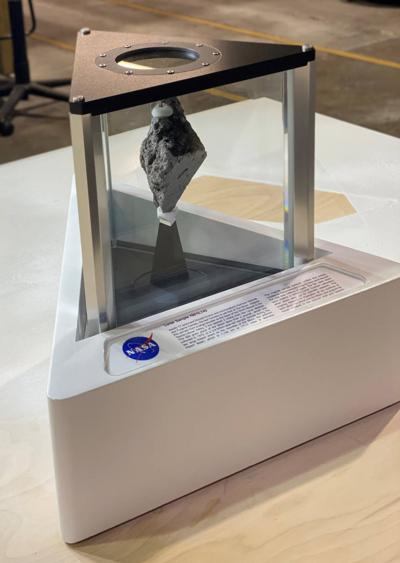
So... In symbolic recognition of earlier generations’ ambitions and accomplishments, and support for America’s current Moon to Mars exploration approach, a Moon rock now sits in the Oval Office of the White House. At the request of the incoming Biden Administration, NASA loaned the Moon rock that was put on display in the Oval Office Jan. 20.

It is from the Lunar Sample Laboratory Facility at NASA’s Johnson Space Center in Houston, and its display case is inscribed with the following:

Apollo 17 astronaut Ronald Evans and moonwalkers Harrison Schmitt and Eugene Cernan, the last humans to set foot on the Moon, chipped this sample from a large boulder at the base of the North Massif in the Taurus-Littrow Valley, 3 km (almost 2 miles) from the Lunar Module. This 332 gram piece of the Moon (less than a pound), which was collected in 1972, is a 3.9-billion-year-old sample formed during the last large impact event on the nearside of the Moon, the Imbrium Impact Basin, which is 1,145 km or 711.5 miles in diameter.

The irregular sample surfaces contain tiny craters created as micrometeorite impacts have sand-blasted the rock over millions of years. The flat, sawn sides were created in NASA’s Lunar Curation Laboratory when slices were cut for scientific research.

NASA notes that, "This ongoing research is imperative as we continue to learn about our planet and the Moon, and prepare for future missions to the cislunar orbit and beyond." 

FMI: www.nasa.gov

Advertisement

More News

Aero-News: Quote of the Day (12.18.25)

“These new aircraft strengthen our ability to respond quickly, train effectively and support communities nationwide. Textron Aviation has been a steadfast supporter in helpin>[...]

Classic Aero-TV: Viking Twin Otter 400--Bringing the DHC-6 Back Into Production

From 2011 (YouTube Edition): Rugged, Legendary, STOL Twin Makes A Comeback The de Havilland Twin Otter is an airplane with a long history, and it gained a reputation as a workhorse>[...]

NTSB Final Report: Rans Employee Flying Club Rans S-6ES Coyote II

A Wind Gust Lifted The Right Wing And The Airplane Turned To The Left Analysis: The pilot was departing from a 2,395-ft-long by 50-ft-wide turf runway. The pilot reported that afte>[...]

ANN FAQ: Submit a News Story!

Have A Story That NEEDS To Be Featured On Aero-News? Here’s How To Submit A Story To Our Team Some of the greatest new stories ANN has ever covered have been submitted by our>[...]

ANN's Daily Aero-Term (12.18.25): Braking Action Advisories

Braking Action Advisories When tower controllers receive runway braking action reports which include the terms “medium," “poor," or “nil," or whenever weather con>[...]

blog comments powered by Disqus



Advertisement

Advertisement

Podcasts

Advertisement

© 2007 - 2025 Web Development & Design by Pauli Systems, LC

