

BAE Systems’ Active Inceptors Earn Certification On G600 And G500 | Aero-News Network
Aero-News Network
RSS icon RSS feed
podcast icon MP3 podcast
Subscribe Aero-News e-mail Newsletter Subscribe

Airborne Unlimited -- Most Recent Daily Episodes

Episode Date

Airborne-Monday

Airborne-Tuesday

Airborne-Wednesday Airborne-Thursday

Airborne-Friday

Airborne On YouTube

Airborne-Unlimited-12.01.25

AirborneNextGen-
12.02.25

Airborne-Unlimited-12.03.25

Airborne-FltTraining-12.04.25

AirborneUnlimited-12.05.25

AFE 2025 LIVE MOSAIC Town Hall (Archived): www.airborne-live.net

Thu, Dec 05, 2019

BAE Systems’ Active Inceptors Earn Certification On G600 And G500

Marks The Second Series Of Certifications For BAE Systems’ Active Sticks In Civil Application

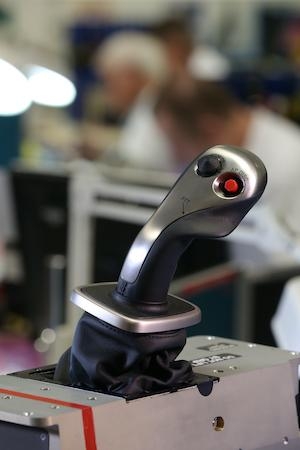
The FAA and EASA have certified active inceptors developed by BAE Systems for Gulfstream's G500 and G600 aircraft. The certifications are from the FAA for the G600 aircraft and EASA for the G500 aircraft. The approvals mark the second series of certifications for BAE Systems’ active sticks in civil applications, which were first certified on Gulfstream’s G500 aircraft last year.

“Our active inceptors will provide pilots of these aircraft with increased situational awareness and enable enhanced handling to maintain a safe and stable flight of Gulfstream’s G500 and G600 aircraft,” said Ehtisham Siddiqui, vice president and general manager of Controls & Avionics Solutions at BAE Systems.

Unlike a passive system, active inceptors, which are part of the controls pilots use to fly an aircraft, have electronically controlled actuators that send tactile feedback to the pilot through the stick. The feedback is programmable for specific aircraft depending on customer requirements, and can warn pilots of impending structural or aerodynamic operating limits. One of the key benefits of active inceptors is the ability to link the pilot and co-pilot controls, so each can see and feel the other’s control inputs in real time.

BAE Systems has been a world leader in active inceptor technology for more than 25 years. The military version of the technology was originally developed for the Joint Strike Fighter program in the 1990s, achieving its first flight on the platform in 2000 and becoming the world’s first certified military active inceptor on the F-35 just six years later. That same core technology achieved a handful of other world firsts, which includes first flight on helicopters such as Blackhawk and Chinook. Today, the company’s active inceptors have flown on 12 different commercial and military aircraft around the world and have logged more than 200,000 flight hours.

(Source: BAE Systems news release. Image from file)

FMI: www.baesystems.com

Advertisement

More News

Classic Aero-TV: VerdeGo Debuts VH-3 Hybrid-Electric Powerplant

From 2023 (YouTube Edition): New Propulsion Scheme Optimized for AAM Applications Founded in 2017 by Eric Bartsch, Pat Anderson, and Erik Lindbergh (grandson of famed aviation pion>[...]

NTSB Prelim: Grumman American Avn. Corp. AA-5B

During The Initial Climb, The Engine Began To Operate Abnormally And, After About Three Seconds, Experienced A Total Loss Of Power On October 29, 2025, about 1820 Pacific daylight >[...]

ANN's Daily Aero-Linx (12.02.25)

Aero Linx: Women in Aviation International Women in Aviation International is the largest nonprofit organization that envisions a world where the sky is open to all, and where avia>[...]

Aero-News: Quote of the Day (12.02.25)

“We’ve paid for the cable line’s repair for the customer and have apologized for the inconvenience this caused them...” Source: Some followup info from an A>[...]

Aero-News: Quote of the Day (12.03.25)

“We have long warned about the devastating effects of pairing optimization. Multiple times over many months, we highlighted how schedule manipulation, unbalanced schedules, a>[...]

blog comments powered by Disqus



Advertisement

Advertisement

Podcasts

Advertisement

© 2007 - 2025 Web Development & Design by Pauli Systems, LC

