
Huerta Tells NTSB Cockpit Electronics Can't Be Made Tamper Proof | Aero-News Network
Aero-News Network
RSS icon RSS feed
podcast icon MP3 podcast
Subscribe Aero-News e-mail Newsletter Subscribe

Airborne Unlimited -- Most Recent Daily Episodes

Episode Date

Airborne-Monday

Airborne-Tuesday

Airborne-Wednesday Airborne-Thursday

Airborne-Friday

Airborne On YouTube

Airborne-Unlimited-12.08.25

AirborneNextGen-
12.09.25

Airborne-Unlimited-12.10.25

Airborne-AffordableFlyers-12.11.25

AirborneUnlimited-12.12.25

AFE 2025 LIVE MOSAIC Town Hall (Archived): www.airborne-live.net

Fri, Jun 12, 2015

Huerta Tells NTSB Cockpit Electronics Can't Be Made Tamper Proof

Comments In A Letter To The Board Concerning Recommendations On 'Black Box' Redesign

FAA Administrator Michael Huerta says that there is no legal reason or technological way for cockpit electronics to be made "tamper proof" in response to a recommendation made by the NTSB.

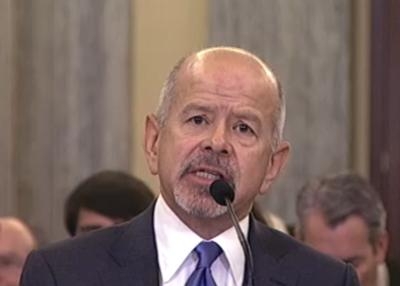
Bloomberg News reports the Huerta (pictured) sent a letter to the NTSB in response to a recommendation to redesign the cockpit voice and flight data recorders in the cockpits of airplanes. “There appears to be no safe way to ensure recorders cannot be intentionally disabled while keeping the airplane safe from electrical failure that could become hazardous,” Huerta wrote in the April 22 letter obtained by Bloomberg.

Huerta also said that there is "no compelling reason" to require airlines to add video recorders to the cockpits of airliners. He said such information would not help investigators in understanding the reason for accidents or intentional crashes such as the Germanwings crash.

In the letter, Huerta cited regulations that require airplanes to be designed in such a way that pilots can shut off electricity to systems in order to diagnose overheating and potential fires in flight. Such a scenario caused a Swissair flight to go down in 1998. The pilots detected smoke in the cockpit but could not cut the power to the in-flight entertainment system to diagnose the problem and contain the ensuing fire. The plane went down near Nova Scotia, resulting in the fatal injury of all 229 people on board. 

“The FAA does not want to introduce design requirements that could expose the airplane to system risks that can lead to cascading failure and fires,” Huerta said in the letter.

FMI: www.faa.gov, www.ntsb.gov

Advertisement

More News

Aero-News: Quote of the Day (12.11.25)

"The owners envisioned something modern and distinctive, yet deeply meaningful. We collaborated closely to refine the flag design so it complemented the aircraft’s contours w>[...]

ANN's Daily Aero-Term (12.11.25): Nonradar Arrival

Nonradar Arrival An aircraft arriving at an airport without radar service or at an airport served by a radar facility and radar contact has not been established or has been termina>[...]

Classic Aero-TV: David Uhl and the Lofty Art of Aircraft Portraiture

From 2022 (YouTube Edition): Still Life with Verve David Uhl was born into a family of engineers and artists—a backdrop conducive to his gleaning a keen appreciation for the >[...]

Airborne-NextGen 12.09.25: Amazon Crash, China Rocket Accident, UAV Black Hawk

Also: Electra Goes Military, Miami Air Taxi, Hypersonics Lab, MagniX HeliStrom Amazon’s Prime Air drones are back in the spotlight after one of its newest MK30 delivery drone>[...]

Airborne 12.05.25: Thunderbird Ejects, Lost Air india 737, Dynon Update

Also: Trailblazing Aviator Betty Stewart, Wind Farm Scrutiny, Chatham Ban Overturned, Airbus Shares Dive A Thunderbird pilot, ID'ed alternately as Thunderbird 5 or Thunderbird 6, (>[...]

blog comments powered by Disqus



Advertisement

Advertisement

Podcasts

Advertisement

© 2007 - 2025 Web Development & Design by Pauli Systems, LC

