
WestPac Tomcats Fly Into The Sunset | Aero-News Network
Aero-News Network
RSS icon RSS feed
podcast icon MP3 podcast
Subscribe Aero-News e-mail Newsletter Subscribe

Airborne Unlimited -- Most Recent Daily Episodes

Episode Date

Airborne-Monday

Airborne-Tuesday

Airborne-Wednesday Airborne-Thursday

Airborne-Friday

Airborne On YouTube

Airborne-Unlimited-12.01.25

AirborneNextGen-
12.02.25

Airborne-Unlimited-12.03.25

Airborne-AffordableFlyers-11.20.25

AirborneUnlimited-11.21.25

LIVE MOSAIC Town Hall (Archived): www.airborne-live.net

Thu, Nov 04, 2004

WestPac Tomcats Fly Into The Sunset

End Of An Aviation Era

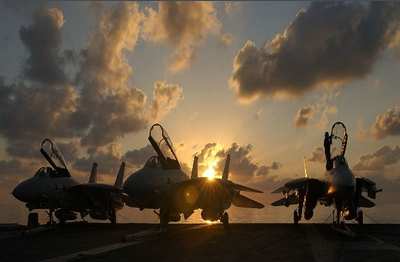
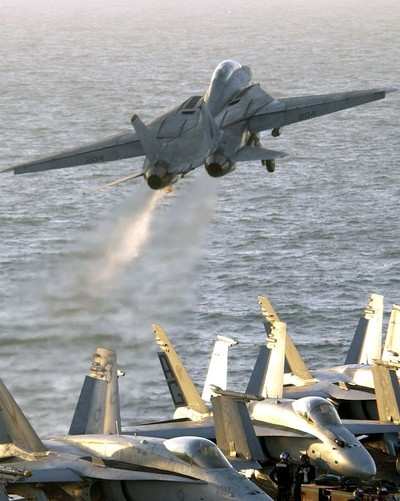
Fighter Squadron (VF) 31 returned home to Naval Air Station (NAS) Oceana on Halloween from a five-month Western Pacific deployment with the nuclear-powered aircraft carrier USS John C. Stennis (CVN 74).

As part of Carrier Air Wing (CVW) 14, the squadron became the last to fly F-14 Tomcats over the skies of the Pacific Fleet.

"Over 30 years, it's been performing an essential mission for the fleet," said Cmdr. Aaron Cudnohufsky, VF-31's commanding officer. "It's been the backbone, the workhorse of the fleet, and it continued that tradition right up to the last day on the West Coast. We'll continue it here on the East Coast."

When NAS Miramar (CA). was transferred to the Marine Corps several years ago, all of the West Coast squadrons were moved to NAS Oceana in Virginia Beach (VA). Since then, California and Washington-based carriers have deployed with Virginia-based Tomcats.

VF-31 will now join the other F-14 squadrons still in commission at NAS Oceana to continue operating in the Atlantic Fleet until the aircraft retires from the Navy in 2006 after more than 30 years of service.

Before the final Tomcats can be laid to rest, the pilots need to be retrained to fly the F/A-18E/F Super Hornet. The East Coast's fleet replacement squadron, Strike Fighter Squadron (VFA) 106, started training its instructor pilots in October.

"We'll train ourselves for a little bit," said Capt. Steve Brennon, VFA-106's commanding officer, "we'll grow our own instructors. We got 12 crews coming out from Lemoore...and they will help us train ourselves through about this fall until we start training students in January."

Rear Adm. Denby Starling, commander of Naval Air Force, US Atlantic Fleet, was in the Navy before the F-14 era began.

"The F-14's been a great airplane and it's done a great job; and the F/A-18, and now the Super Hornet, followed up with the JSF (Joint Strike Fighter) - better airplanes, more capability; and Oceana will still be here flying."

(ANN salutes Journalist 1st Class Donald P. Rule, Naval Media Center Fleet Support Detachment, Norfolk)

FMI: www.news.navy.mil/local/nmcnorfolk

Advertisement

More News

ANN's Daily Aero-Term (12.01.25): Convective SIGMET

Convective SIGMET A weather advisory concerning convective weather significant to the safety of all aircraft. Convective SIGMETs are issued for tornadoes, lines of thunderstorms, e>[...]

ANN's Daily Aero-Linx (12.01.25)

Aero Linx: United Flying Octogenarians WELCOME to a most extraordinary group of aviators, the United Flying Octogenarians (UFO). Founded in 1982 with just a handful of pilots, we h>[...]

NTSB Final Report: Remos Aircraft GmbH Remos GX

Pilot’s Decision To Attempt Takeoff With Frost Covering The Airplane’s Wings Analysis: The pilot of the light sport airplane was preparing to depart for a cross-country>[...]

Aero-News: Quote of the Day (12.02.25)

“We’ve paid for the cable line’s repair for the customer and have apologized for the inconvenience this caused them...” Source: Some followup info from an A>[...]

ANN's Daily Aero-Term (12.02.25): Coupled Approach

Coupled Approach An instrument approach performed by the aircraft autopilot, and/or visually depicted on the flight director, which is receiving position information and/or steerin>[...]

blog comments powered by Disqus



Advertisement

Advertisement

Podcasts

Advertisement

© 2007 - 2025 Web Development & Design by Pauli Systems, LC

