Fri, Nov 06, 2015
Before An Amphibious Airplane Can Fly It Must Float, And Rutan’s New SkiGull Recently Got Its First Dip In The Water
The SkiGull is a next-generation seaplane developed by Rutan and Regan Designs. The aircraft is designed to land on a variety of surfaces (water, snow, and unimproved land), allowing access to remote areas like never before. As could be expected, it is Burt Rutan at his best designing and building an airplane for his personal use.
According to a report from the Coeur d'Alene Press, Burt Rutan, along with a group of skilled supporters, placed his SkiGull in the water for the first time and commenced with testing its water capabilities.
The report indicated that when taxiing at low speeds, the amphibian handled very well, stability was good, and the water rudder was very effective. The low-speed testing was in the range of 4 to 8 knots. However, as the taxi speed was later increased it was determined the pitch angle of the hull was too low.
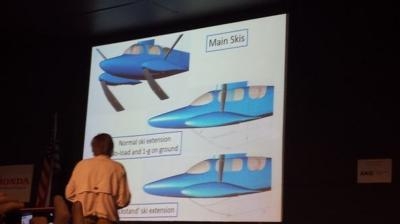
It’s reported that the water taxi speeds were increased to about 18 knots and that wakes from other boats were crossed successfully, but the low pitch angle caused spray over the windshield that limited vision. While most seaplanes achieve high speed taxi stability by “running on the step,” Rutan’s design is unique in that it has retractable skis that can be extended for high speed water taxi and are intended to provide takeoff and landing capabilities in rough water conditions and other surfaces like snow and ice.

These initial taxi tests indicated that the pitch problem will have to be resolved before the skis can be used. In the article, Rutan was quoted as saying, “I was delighted with the low speed maneuverability and how easy it was to launch and recover the SkiGull. The engine started easily and ran smoothly on the Swift aviation fuel and all other systems performed as expected. As for improving the pitch trim, we have several options that we are evaluating. Overall I am very pleased with the results of our testing so far.”
In the classic Rutan style, testing challenges simply provide guidance to move in the right direction to achieve the desired outcome.
(Images from file)
More News
From 2023 (YouTube Edition): New Propulsion Scheme Optimized for AAM Applications Founded in 2017 by Eric Bartsch, Pat Anderson, and Erik Lindbergh (grandson of famed aviation pion>[...]
During The Initial Climb, The Engine Began To Operate Abnormally And, After About Three Seconds, Experienced A Total Loss Of Power On October 29, 2025, about 1820 Pacific daylight >[...]
Aero Linx: Women in Aviation International Women in Aviation International is the largest nonprofit organization that envisions a world where the sky is open to all, and where avia>[...]
“We’ve paid for the cable line’s repair for the customer and have apologized for the inconvenience this caused them...” Source: Some followup info from an A>[...]
“We have long warned about the devastating effects of pairing optimization. Multiple times over many months, we highlighted how schedule manipulation, unbalanced schedules, a>[...]



 Classic Aero-TV: VerdeGo Debuts VH-3 Hybrid-Electric Powerplant


 See All