
NOAA-N Prime Satellite Lifts Off From Vandenberg SLC-2 | Aero-News Network
Aero-News Network
RSS icon RSS feed
podcast icon MP3 podcast
Subscribe Aero-News e-mail Newsletter Subscribe

Airborne Unlimited -- Most Recent Daily Episodes

Episode Date

Airborne-Monday

Airborne-Tuesday

Airborne-Wednesday Airborne-Thursday

Airborne-Friday

Airborne On YouTube

Airborne-Unlimited-12.01.25

AirborneNextGen-
12.02.25

Airborne-Unlimited-12.03.25

Airborne-FltTraining-12.04.25

AirborneUnlimited-12.05.25

AFE 2025 LIVE MOSAIC Town Hall (Archived): www.airborne-live.net

Fri, Feb 06, 2009

NOAA-N Prime Satellite Lifts Off From Vandenberg SLC-2

Weather Research Station Joins Two Others In Polar Orbit

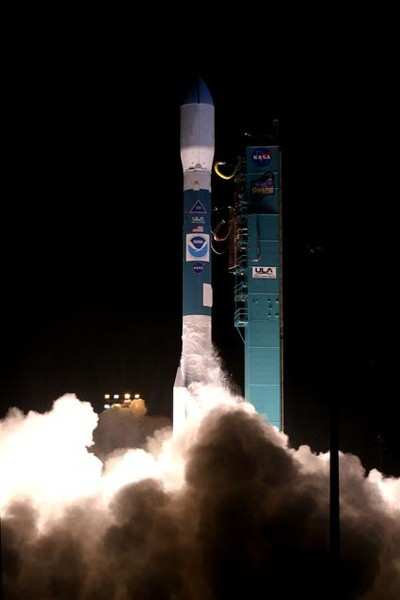
The third time WAS the charm for NASA and the National Oceanic and Atmospheric Association. The Delta II booster carrying the NOAA-N Prime research satellite lifted off early Friday morning from Space Launch Complex-2 at Vandenberg Air Force Base in California.

The countdown proceeded smoothly throughout the night, and up to T-minus zero at 2:22 am Pacific time. Neither the spacecraft nor the United Launch Alliance Delta II launch vehicle experienced any technical issues, and the weather conditions remained favorable.

NOAA-N Prime -- also known as NOAA-19 -- joins NOAA-18 and one European environmental satellite already in polar orbit. NOAA-Prime carries seven scientific instruments, including two search and rescue instruments and a data recording system.

Unique with this satellite is a new data collection system that will relay meteorological, oceanographic data – even track migration patterns of wildlife – to help researchers improve their study of Earth’s environment.

Data from NOAA-19 will support several NOAA programs, including weather analysis and forecasting, climate research, and detection of forest fires and volcanic eruptions.

NOAA operates two types of satellite systems for the United States -- geostationary and polar-orbiting. Geostationary satellites constantly monitor the Western Hemisphere from around 22,240 miles above the Earth, and polar-orbiting satellites circle the Earth providing global information from approximately 540 miles above the Earth.

As ANN reported, the first targeted launch attempt Wednesday was scrubbed, when a launch pad gaseous nitrogen pressurization system failed. Engineers commenced immediate repairs to that system, in hopes of launching the satellite Thursday... but then a pad-mounted air conditioning compressor, which supplies cold, dry air under the payload fairing surrounding the sensitive satellite, also failed.

FMI: www.nasa.gov, www.noaa.gov

Advertisement

More News

Classic Aero-TV: VerdeGo Debuts VH-3 Hybrid-Electric Powerplant

From 2023 (YouTube Edition): New Propulsion Scheme Optimized for AAM Applications Founded in 2017 by Eric Bartsch, Pat Anderson, and Erik Lindbergh (grandson of famed aviation pion>[...]

NTSB Prelim: Grumman American Avn. Corp. AA-5B

During The Initial Climb, The Engine Began To Operate Abnormally And, After About Three Seconds, Experienced A Total Loss Of Power On October 29, 2025, about 1820 Pacific daylight >[...]

ANN's Daily Aero-Linx (12.02.25)

Aero Linx: Women in Aviation International Women in Aviation International is the largest nonprofit organization that envisions a world where the sky is open to all, and where avia>[...]

Aero-News: Quote of the Day (12.02.25)

“We’ve paid for the cable line’s repair for the customer and have apologized for the inconvenience this caused them...” Source: Some followup info from an A>[...]

Aero-News: Quote of the Day (12.03.25)

“We have long warned about the devastating effects of pairing optimization. Multiple times over many months, we highlighted how schedule manipulation, unbalanced schedules, a>[...]

blog comments powered by Disqus



Advertisement

Advertisement

Podcasts

Advertisement

© 2007 - 2025 Web Development & Design by Pauli Systems, LC

