
DC-3 Down In Antarctica, All Safe | Aero-News Network
Aero-News Network
RSS icon RSS feed
podcast icon MP3 podcast
Subscribe Aero-News e-mail Newsletter Subscribe

Airborne Unlimited -- Most Recent Daily Episodes

Episode Date

Airborne-Monday

Airborne-Tuesday

Airborne-Wednesday Airborne-Thursday

Airborne-Friday

Airborne On YouTube

Airborne-SpecialEpisode-12.15.25

AirborneNextGen-
12.16.25

Airborne-Unlimited-12.10.25

Airborne-AffordableFlyers-12.11.25

AirborneUnlimited-12.12.25

AFE 2025 LIVE MOSAIC Town Hall (Archived): www.airborne-live.net

Sat, Dec 22, 2007

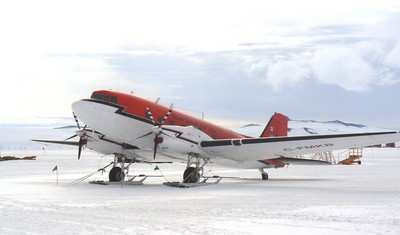
DC-3 Down In Antarctica, All Safe

NSF-Chartered Plane Crashed On Takeoff Near Mt. Patterson

All 10 people onboard a Basler DC-3 chartered by the National Science Foundation are safe, after the aircraft crashed on takeoff earlier this week in Antarctica. The turboprop-converted workhorse was providing support to a group of researchers at a remote location on the southernmost continent.

According to NSF, the aircraft -- owned by Kenn Borek Air Ltd., a Canadian aviation firm -- experienced difficulties in taking off from a field site near Mt. Patterson in West Antarctica on the morning of December 20, local time (US stations in Antarctica keep New Zealand time), roughly 550 miles from McMurdo Station, NSF's logistical hub in Antarctica.

The six passengers aboard the plane were part of the NSF-funded portion of the international Polar Earth Observatory Network (POLENET) project, which is deploying GPS units and seismic sensors across Antarctica to make observations that are vital to understanding how the massive ice sheets are changing. In turn, these measurements are critical to understanding how ice sheets affect sea level worldwide, and thereby global climate in general.

The POLENET team and four aircraft crewmembers were flown back to McMurdo Station.

As a matter of routine, the incident is under investigation by the Department of the Interior's Aircraft Management Division (AMD). NSF has a memorandum of agreement with the Interior Department to conduct such investigations. As the managing federal agency for the US Antarctic Program, NSF coordinates and supports all US scientific research on the southernmost continent and in surrounding waters.

AMD has contacted the National Transportation Safety Board (NTSB) about the incident. The NTSB will coordinate as necessary with the Transportation Safety Board of Canada.

Because the cause of the accident is under investigation, NSF says it will have no further comment, pending the conclusion of that investigation.

FMI: www.nsf.gov

Advertisement

More News

ANN's Daily Aero-Term (12.19.25): Ultrahigh Frequency (UHF)

Ultrahigh Frequency (UHF) The frequency band between 300 and 3,000 MHz. The bank of radio frequencies used for military air/ground voice communications. In some instances this may >[...]

NTSB Prelim: Cirrus Design Corp SR22T

During The 7 Second Descent, There Was Another TAWS Alert At Which Time The Engine Remained At Full Power On October 24, 2025 at 2115 mountain daylight time, a Cirrus SR22T, N740TS>[...]

Classic Aero-TV: The Red Tail Project--Carrying the Torch of the Tuskegee Airmen

From 2009 (YouTube Edition): Educational Organization Aims to Inspire by Sharing Tuskegee Story Founding leader Don Hinz summarized the Red Tail Project’s mission in simple, >[...]

Aero-News: Quote of the Day (12.19.25)

“This feels like an important step since space travel for people with disabilities is still in its very early days... I’m so thankful and hope it inspires a change in m>[...]

Airborne 12.17.25: Skydiver Hooks Tail, Cooper Rotax Mount, NTSB v NDAA

Also: New Katanas, Kern County FD Training, IndiGo’s Botched Roster, MGen. Leavitt Named ERAU Dean The Australian Transportation Safety Bureau (ATSB) has wrapped up its inves>[...]

blog comments powered by Disqus



Advertisement

Advertisement

Podcasts

Advertisement

© 2007 - 2025 Web Development & Design by Pauli Systems, LC

