
TSB’s Bearskin 311 Investigation Report Highlights Importance Of Pilot Training | Aero-News Network
Aero-News Network
RSS icon RSS feed
podcast icon MP3 podcast
Subscribe Aero-News e-mail Newsletter Subscribe

Airborne Unlimited -- Most Recent Daily Episodes

Episode Date

Airborne-Monday

Airborne-Tuesday

Airborne-Wednesday Airborne-Thursday

Airborne-Friday

Airborne On YouTube

Airborne-Unlimited-12.08.25

AirborneNextGen-
12.09.25

Airborne-Unlimited-12.10.25

Airborne-AffordableFlyers-12.11.25

AirborneUnlimited-12.12.25

AFE 2025 LIVE MOSAIC Town Hall (Archived): www.airborne-live.net

Thu, Apr 16, 2015

TSB’s Bearskin 311 Investigation Report Highlights Importance Of Pilot Training

Loss Of Power In The Airplane's Left Engine Contributed To The Accident, TSB Says In Report

The Transportation Safety Board of Canada (TSB) has released its final report on Bearskin Airlines Flight 311, making it clear that multiple factors were responsible for the November 10, 2013, accident.

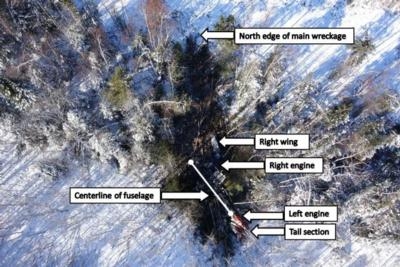
According to the report, on November 10, 2013 a Bearskin Airlines Fairchild SA227 Metro III, on a flight from Sioux Lookout, Ontario, was on final approach to the Red Lake airport. The crew reported that they were 5 miles from the airport, and shortly thereafter declared an emergency. The aircraft struck trees along with some power lines, and was destroyed by a post-impact fire. Two passengers were able to evacuate the aircraft with non-life threatening injuries.

The investigation found that the crew experienced a near total loss of power in the left engine at 500 feet above ground level due to a failure of an internal engine component. The crew was unable to identify the nature of the engine malfunction, preventing them from taking timely action to control the aircraft. The aircraft’s landing configuration generated higher drag which, combined with the engine malfunction, resulted in the aircraft losing airspeed in an asymmetric power state. As the aircraft slowed, the crew lost control at an altitude from which a recovery was not possible.

Following the occurrence, the aircraft operator revised its single engine and engine failure procedures to ensure that the propeller on a malfunctioning engine does not cause excessive drag. Honeywell, the engine manufacturer, increased the inspection frequency on fuel nozzles and clarified inspection procedures. Transport Canada issued a Civil Aviation Safety Alert regarding issues with the negative torque sensing (NTS) system on Honeywell TPE-331 engines, to emphasize the need to feather and secure propellers during engine power loss events.
 
“Our sympathies go out to all those affected by this tragic accident,” said Capt. Tim Canoll, ALPA president. “It is incumbent on all of us to take these lessons learned and implement changes to prevent similar accidents in the future. We look forward to continuing to work cooperatively and closely with the Minister of Transport, other government officials, and airline industry representatives to address the safety issues identified in this accident.”
 
ALPA praised the TSB’s in-depth analysis of the complex technical factors that led to this accident and is encouraged by the changes identified in the final report, which Bearskin and Transport Canada are implementing.
 
“As reaffirmed by the TSB’s report, pilots must be given the system knowledge, tools, and skills to be able to respond to unexpected, abnormal, and potentially hazardous situations,” said Capt. Dan Adamus, ALPA Canada Board president.
 
For decades, ALPA has advocated for improved aircraft design that would provide flight crews with a clear signal of any malfunction, which was not the case in this accident.

(Image from TSB report)

FMI: www.alpa.org

Advertisement

More News

ANN's Daily Aero-Term (12.13.25): Light Gun

Light Gun A handheld directional light signaling device which emits a brilliant narrow beam of white, green, or red light as selected by the tower controller. The color and type of>[...]

Aero-News: Quote of the Day (12.13.25)

“We have performed extensive ground testing by comparing warm up times, full power tethered pulls, and overall temperatures in 100 degree environments against other aircraft >[...]

NTSB Final Report: Gippsland GA-8

While Taxiing To Parking The Right Landing Gear Leg Collapsed, Resulting In Substantial Damage Analysis: The pilot made a normal approach with full flaps and landed on the runway. >[...]

Classic Aero-TV: Historically Unique -- Marlin Horst's Exquisite Fairchild 71

From 2014 (YouTube Edition): Exotic Rebuild Reveals Aerial Work Of Art During EAA AirVenture 2014, ANN's Michael Maya Charles took the time to get a history lesson about a great ai>[...]

Airborne 12.12.25: Global 8000, Korea Pilot Honors, AV-30 Update

Also: Project Talon, McFarlane Acquisition, Sky-Tec Service, JPL Earth Helo Tests Bombardier has earned a round of applause from the business aviation community, celebrating the fo>[...]

blog comments powered by Disqus



Advertisement

Advertisement

Podcasts

Advertisement

© 2007 - 2025 Web Development & Design by Pauli Systems, LC

