
FAA Proposes Improvements For South Florida Airspace | Aero-News Network
Aero-News Network
RSS icon RSS feed
podcast icon MP3 podcast
Subscribe Aero-News e-mail Newsletter Subscribe

Airborne Unlimited -- Most Recent Daily Episodes

Episode Date

Airborne-Monday

Airborne-Tuesday

Airborne-Wednesday Airborne-Thursday

Airborne-Friday

Airborne On YouTube

Airborne-Unlimited-12.08.25

AirborneNextGen-
12.09.25

Airborne-Unlimited-12.10.25

Airborne-AffordableFlyers-12.11.25

AirborneUnlimited-12.12.25

AFE 2025 LIVE MOSAIC Town Hall (Archived): www.airborne-live.net

Fri, Jun 14, 2019

FAA Proposes Improvements For South Florida Airspace

The Plan Will Not Change Existing Flight Paths Or The Altitudes That Aircraft Currently Fly

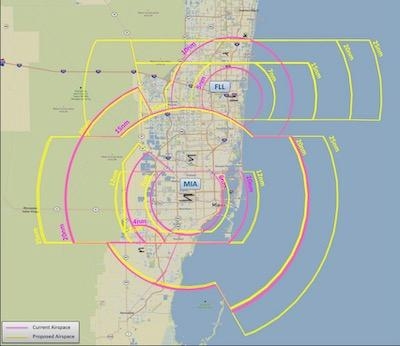
The FAA is proposing to modify the airspace over South Florida to enhance safety. The plan will not change existing flight paths or the altitudes that aircraft currently fly, and it will not result in more flights over the area, the agency says. The graphic depicts the details of the proposed changes.

The proposal would expand the airspace where air traffic controllers track flights and communicate with pilots, which is operating on Instrument Flight Rules (IFR). It increases safety by ensuring that all flights including aircraft operating on Visual Flight Rules (VFR) close to Fort Lauderdale-Hollywood (KFLL) and Miami (KMIA) international airports are under direct air traffic control.  

The FAA categorizes the airspace surrounding KMIA as “Class B,” the most restrictive airspace around the busiest airports in the country. KMIA Class B airspace extends to 20 nautical miles around the airport up to 7,000 feet in altitude. The proposal would expand the Class B airspace out to 25 nautical miles east and west of the airport. The top or “ceiling” of the controlled airspace will remain at 7,000 feet. The bottom or “floor” of the Class B airspace gradually increases from the surface to 4000 feet as it extends farther from the airport.

The airspace around KFLL is “Class C,” which is less restrictive, but highly controlled. The KFLL Class C airspace extends to 10 nautical miles up to 4,000 feet in altitude. The proposal would extend the Class C airspace to 25 nautical miles to the east and 20 nautical miles to the west. The ceiling remains at 4,000 feet and the floor gradually increases from the surface to 3,000 feet as the airspace extends farther from the airport.   

Aircraft that are flying VFR may fly under or around the Class B and C airspace without requiring air traffic control service.  

The plan is not part of the FAA’s South-Central Florida Metroplex, which aims to replace dozens of existing flight procedures with satellite-based routes, enhancing safety and efficiency of flights over the state.

The agency will hold a workshop on the proposal from 3 to 5 p.m., June 12, 2019, at Broward College South Campus, Building 69, Room 133; 7200 Pines Blvd., Pembroke Pines, FL, 33024. Attendees may submit comments at the workshop and by email no later than Aug. 11, 2019.

The FAA changes airspace through the federal rulemaking process. After the comment period closes, we will consolidate and review the comments and incorporate modifications into the final proposal. We anticipate issuing a Notice of Proposed Rulemaking (NPRM) in 2020. We will consider public comments on the NPRM, and publish a final rule that officially will modify the airspace.  

The "National Environmental Policy Act of 1969" (NEPA) requires the FAA to identify and publicly disclose any potential environmental impacts of the proposed airspace modifications. We will conduct an environmental review and offer the public the opportunity to comment on the proposal again during the environmental process.  

(Source: FAA. Graphic provided)

FMI: www.faa.gov

Advertisement

More News

ANN's Daily Aero-Linx (12.12.25)

Aero Linx: Commercial Aviation Safety Team (CAST) Founded in 1997, the Commercial Aviation Safety Team (USCAST) has developed an integrated, data-driven strategy to reduce the comm>[...]

ANN's Daily Aero-Term (12.12.25): Land And Hold Short Operations

Land And Hold Short Operations Operations that include simultaneous takeoffs and landings and/or simultaneous landings when a landing aircraft is able and is instructed by the cont>[...]

ANN FAQ: How Do I Become A News Spy?

We're Everywhere... Thanks To You! Even with the vast resources and incredibly far-reaching scope of the Aero-News Network, every now and then a story that should be reported on sl>[...]

NTSB Final Report: Cirrus Design Corp SF50

Pilot’s Inadvertent Use Of The Landing Gear Control Handle Instead Of The Flaps Selector Switch During The Landing Rollout Analysis: The pilot reported that during the landin>[...]

Airborne 12.08.25: Samaritan’s Purse Hijack, FAA Med Relief, China Rocket Fail

Also: Cosmonaut Kicked Out, Airbus Scales Back, AF Silver Star, Russian A-60 Clobbered A Samaritan’s Purse humanitarian flight was hijacked on Tuesday, December 2, while atte>[...]

blog comments powered by Disqus



Advertisement

Advertisement

Podcasts

Advertisement

© 2007 - 2025 Web Development & Design by Pauli Systems, LC

