
Hubble Accidentally Discovers A New Galaxy In The 'Cosmic Neighborhood' | Aero-News Network
Aero-News Network
RSS icon RSS feed
podcast icon MP3 podcast
Subscribe Aero-News e-mail Newsletter Subscribe

Airborne Unlimited -- Most Recent Daily Episodes

Episode Date

Airborne-Monday

Airborne-Tuesday

Airborne-Wednesday Airborne-Thursday

Airborne-Friday

Airborne On YouTube

Airborne-Unlimited-12.08.25

AirborneNextGen-
12.09.25

Airborne-Unlimited-12.10.25

Airborne-AffordableFlyers-12.11.25

AirborneUnlimited-12.12.25

AFE 2025 LIVE MOSAIC Town Hall (Archived): www.airborne-live.net

Mon, Feb 11, 2019

Hubble Accidentally Discovers A New Galaxy In The 'Cosmic Neighborhood'

New Galaxy Is 'Only' 30 Million Light Years From The Milky Way

The universe is very cluttered. Myriad island cities of stars, the galaxies, form a backdrop tapestry. Much closer to home are nebulae, star clusters and assorted other foreground celestial objects that are mostly within our Milky Way galaxy. Despite the vastness of space, objects tend to get in front of each other.

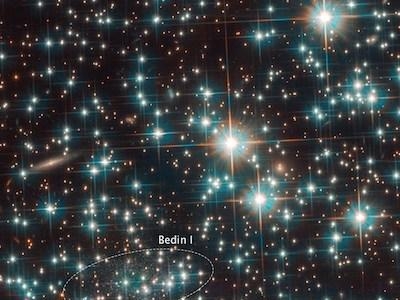
This happened when astronomers used the Hubble Space Telescope to photograph the globular star cluster NGC 6752 (located 13,000 light-years away in our Milky Way's halo). In a celestial game of "Where's Waldo?" Hubble's sharp vision uncovered a never-before-seen dwarf galaxy located far behind the cluster's crowded stellar population. The loner galaxy is in our own cosmic backyard, only 30 million light-years away (approximately 2,300 times farther than the foreground cluster).
cluster of bright stars with distant galaxy outlined

The object is classified as a dwarf spheroidal galaxy because it measures only around 3,000 light-years at its greatest extent (barely 1/30th the diameter of the Milky Way), and it is roughly a thousand times dimmer than the Milky Way.

Because of its 13-billion-year-old age, and its isolation — which resulted in hardly any interaction with other galaxies — the dwarf is the astronomical equivalent of a living fossil from the early universe.

The international team of astronomers that carried out this study consists of L. Bedin (INAF-Astronomical Observatory of Padua, Italy), M. Salaris (Liverpool John Moores University, Liverpool, England, UK), R. Rich (University of California, Los Angeles, California, USA), H. Richer (University of British Columbia, Vancouver, British Columbia, Canada), J. Anderson (Space Telescope Science Institute, Baltimore, Maryland, USA), B. Bettoni (INAF-Astronomical Observatory of Padua, Italy), D. Nardiello, A. Milone and A. Marino (University of Padua, Italy), M. Libralato and A. Bellini (Space Telescope Science Institute, Baltimore, Maryland, USA), A. Dieball (University of Bonn, Bonn, Germany), P. Bergeron (University of Montreal, Quebec, Canada), A. Burgasser (University of California, San Diego, California, USA) and D. Apai (University of Arizona, Tucson, Arizona, USA).

The science team's results will be published online January 31, 2019, in the Monthly Notices of the Royal Astronomical Society: Letters.

(Image provided with NASA news release)

FMI: www.nasa.gov

Advertisement

More News

Aero-News: Quote of the Day (12.09.25)

“We respectfully call on the City of Mesa to: 1. Withdraw the landing fee proposal immediately 2. Engage with the aviation community before making decisions that impact safet>[...]

ANN's Daily Aero-Term (12.09.25): High Speed Taxiway

High Speed Taxiway A long radius taxiway designed and provided with lighting or marking to define the path of aircraft, traveling at high speed (up to 60 knots), from the runway ce>[...]

ANN's Daily Aero-Linx (12.09.25)

Aero Linx: International Federation of Airworthiness (IFA) IFA uniquely combines together all those with responsibility for policies, principles and practices concerned with the co>[...]

NTSB Final Report: Diamond Aircraft Ind Inc DA20C1 (A1); Robinson Helicopter R44

Controller’s Expectation That VW02 Would Have Departed Sooner Led To An Inadequate Scan And Loss Of Situational Awareness Analysis: A Robinson R-44 helicopter N744AF, VW02 (V>[...]

ANN FAQ: Q&A 101

A Few Questions AND Answers To Help You Get MORE Out of ANN! 1) I forgot my password. How do I find it? 1) Easy... click here and give us your e-mail address--we'll send it to you >[...]

blog comments powered by Disqus



Advertisement

Advertisement

Podcasts

Advertisement

© 2007 - 2025 Web Development & Design by Pauli Systems, LC

