

NASA: Return To Flight Unlikely This Year | Aero-News Network
Aero-News Network
RSS icon RSS feed
podcast icon MP3 podcast
Subscribe Aero-News e-mail Newsletter Subscribe

Airborne Unlimited -- Most Recent Daily Episodes

Episode Date

Airborne-Monday

Airborne-Tuesday

Airborne-Wednesday Airborne-Thursday

Airborne-Friday

Airborne On YouTube

Airborne-Unlimited-12.01.25

AirborneNextGen-
12.02.25

Airborne-Unlimited-12.03.25

Airborne-FltTraining-12.04.25

AirborneUnlimited-12.05.25

AFE 2025 LIVE MOSAIC Town Hall (Archived): www.airborne-live.net

Sun, Feb 15, 2004

NASA: Return To Flight Unlikely This Year

Shuttle Mods Taking Longer Than Hoped

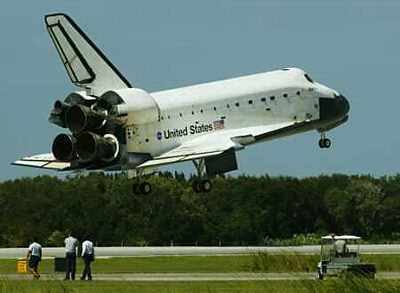
The chance that America's shuttle fleet will return to flight by September or October is growing mighty slim. So says NASA Administrator Sean O'Keefe.

"I have my doubts the September-October time frame will be met," O'Keefe said. "We will determine that next week."

Florida Today, a newspaper which closely tracks developments at the Kennedy Space Center, modifications to add cameras and sensors to inspect Atlantis while in orbit have run into difficulty and are weeks behind schedule. At the time, two NASA directors told the newspaper that it would be tough to make Atlantis ready for flight as planned -- during the month of September.

There is also the ongoing issue of trying to solve the falling insulation problem. The Columbia Accident Investigation Board has said a falling piece of insulation foam from the doomed shuttle's external fuel tank most likely tore a hole in the left wing, allowing superheated gasses to breach the vehicle upon re-entry. That, according to the CAIB, is what caused Columbia to disintegrate over Texas and Louisiana a year ago, killing all seven astronauts on board. No shuttle has flown since.

NASA has stated it's determined to meet the fall launch window. Now, that goal seems in doubt.

Part of the CAIB recommendations on improving flight safety -- recommendations O'Keefe has vowed NASA will follow to the letter -- calls for the shuttle to launch only during daylight and only when the huge orange external fuel tank can be dropped on the side of the Earth facing the sun. The idea is to allow NASA to take detailed photos of the orbiter so they can be inspected for signs of launch-related damage.

If you do the calculations, you'll find that leaves some fairly restrictive windows for a return to flight this fall. Under the guidelines, Atlantis can launch between mid-September and mid-October. It can also launch in November. But if modifications aren't complete by then, Atlantis won't be able to launch again until another such opportunity arises in March, 2005.

FMI: www.nasa.gov/news/highlights/returntoflight.html

Advertisement

More News

Aero-FAQ: Dave Juwel's Aviation Marketing Stories -- ITBOA BNITBOB

Dave Juwel's Aviation Marketing Stories ITBOA BNITBOB ... what does that mean? It's not gibberish, it's a lengthy acronym for "In The Business Of Aviation ... But Not In The Busine>[...]

NTSB Prelim: Rutan Long-EZ

The Pilot Attempted Several Times To Restart The Engine And Diverted To Long Beach Airport/Daughtery Field On October 20, 2025, about 1603 Pacific daylight time, an experimental am>[...]

ANN's Daily Aero-Term (12.05.25): Hazardous Weather Information

Hazardous Weather Information Summary of significant meteorological information (SIGMET/WS), convective significant meteorological information (convective SIGMET/WST), urgent pilot>[...]

Aero-News: Quote of the Day (12.05.25)

"The latest development underscores the government of Malaysia’s commitment in providing closure to the families affected by this tragedy..." Source: From statements made by >[...]

Airborne-Flight Training 12.04.25: Ldg Fee Danger, Av Mental Health, PC-7 MKX

Also: IAE Acquires Diamond Trainers, Army Drones, FedEx Pilots Warning, DA62 MPP To Dresden Tech Uni The danger to the flight training industry and our future pilots is clear. Dona>[...]

blog comments powered by Disqus



Advertisement

Advertisement

Podcasts

Advertisement

© 2007 - 2025 Web Development & Design by Pauli Systems, LC

