
India's Chandrayaan-1 Now In Lunar Orbit | Aero-News Network
Aero-News Network
RSS icon RSS feed
podcast icon MP3 podcast
Subscribe Aero-News e-mail Newsletter Subscribe

Airborne Unlimited -- Most Recent Daily Episodes

Episode Date

Airborne-Monday

Airborne-Tuesday

Airborne-Wednesday Airborne-Thursday

Airborne-Friday

Airborne On YouTube

Airborne-Unlimited-12.08.25

AirborneNextGen-
12.09.25

Airborne-Unlimited-12.10.25

Airborne-AffordableFlyers-12.11.25

AirborneUnlimited-12.12.25

AFE 2025 LIVE MOSAIC Town Hall (Archived): www.airborne-live.net

Tue, Nov 11, 2008

India's Chandrayaan-1 Now In Lunar Orbit

Gradually Pulling Closer To Surface

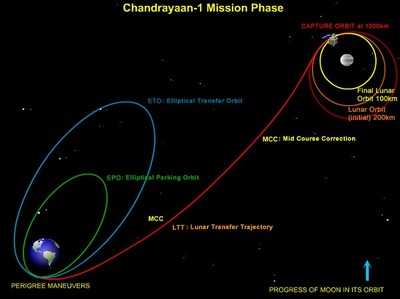
Chandrayaan-1, the Indian Space Research Organization's (ISRO) lunar orbiter, was captured into orbit around the Moon on November 8. One day later, the spacecraft performed a maneuver that lowered the closest point of its orbit down to 200 km from the Moon.

The spacecraft's liquid-fuel propelled engine was fired at 12:21 CET (16:51 Indian Standard Time) when it was at a distance of about 500 km from the Moon. This reduced the spacecraft's velocity, enabling the Moon's gravitational field to capture Chandrayaan-1 into lunar orbit. In this configuration, the orbit's point closest to the lunar surface was at 504 km and the spacecraft circled the Moon in 11 hours.

This lunar orbit insertion maneuver was executed from the Chandrayaan-1 Spacecraft Control Center at ISRO's Telemetry, Tracking and Command Network at Bangalore. The performance of all the systems on board Chandrayaan-1 was registered as normal.

On Monday, at 15:33 CET (20:03 Indian Standard Time), the spacecraft's engine was fired for about 57 seconds, reducing the orbit's point closest to the lunar surface to 200 km while the farthest point remained unchanged at 7502 km. In this elliptical orbit, Chandrayaan-1 takes about ten and a half hours to circle the Moon once.

Over the next few days, the height of the spacecraft's orbit around the Moon will be carefully reduced in steps to achieve a final 100-km polar lunar orbit. The Moon Impact Probe (MIP) will then be released to hit the lunar surface, after which the other instruments on board will be turned on.

As ANN reported, Chandrayaan-1 was launched October 22 by from India's spaceport at Satish Dhawan Space Center SHAR, Sriharikota. The launcher placed the spacecraft in an elliptical orbit around Earth.

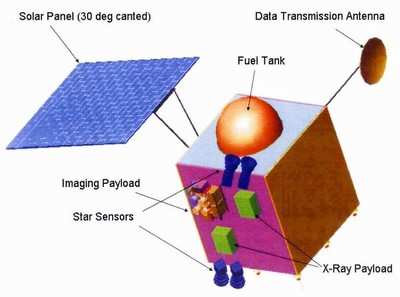
In the past two weeks, the Terrain Mapping Camera (TMC), one of the 11 scientific instruments of the spacecraft, was successfully operated twice to take pictures, according to the ISRO.

FMI: www.isro.org/, www.chandrayaan-i.com/index.html

Advertisement

More News

Aero-News: Quote of the Day (12.09.25)

“We respectfully call on the City of Mesa to: 1. Withdraw the landing fee proposal immediately 2. Engage with the aviation community before making decisions that impact safet>[...]

ANN's Daily Aero-Term (12.09.25): High Speed Taxiway

High Speed Taxiway A long radius taxiway designed and provided with lighting or marking to define the path of aircraft, traveling at high speed (up to 60 knots), from the runway ce>[...]

ANN's Daily Aero-Linx (12.09.25)

Aero Linx: International Federation of Airworthiness (IFA) IFA uniquely combines together all those with responsibility for policies, principles and practices concerned with the co>[...]

NTSB Final Report: Diamond Aircraft Ind Inc DA20C1 (A1); Robinson Helicopter R44

Controller’s Expectation That VW02 Would Have Departed Sooner Led To An Inadequate Scan And Loss Of Situational Awareness Analysis: A Robinson R-44 helicopter N744AF, VW02 (V>[...]

ANN FAQ: Q&A 101

A Few Questions AND Answers To Help You Get MORE Out of ANN! 1) I forgot my password. How do I find it? 1) Easy... click here and give us your e-mail address--we'll send it to you >[...]

blog comments powered by Disqus



Advertisement

Advertisement

Podcasts

Advertisement

© 2007 - 2025 Web Development & Design by Pauli Systems, LC

