

UAS Gives Scientists 3D View Of Atmosphere | Aero-News Network
Aero-News Network
RSS icon RSS feed
podcast icon MP3 podcast
Subscribe Aero-News e-mail Newsletter Subscribe

Airborne Unlimited -- Most Recent Daily Episodes

Episode Date

Airborne-Monday

Airborne-Tuesday

Airborne-Wednesday Airborne-Thursday

Airborne-Friday

Airborne On YouTube

Airborne-Unlimited-12.08.25

AirborneNextGen-
12.09.25

Airborne-Unlimited-12.10.25

Airborne-AffordableFlyers-12.11.25

AirborneUnlimited-12.12.25

AFE 2025 LIVE MOSAIC Town Hall (Archived): www.airborne-live.net

Mon, Jan 11, 2010

UAS Gives Scientists 3D View Of Atmosphere

Trio Of Aircraft Used In Climate Research

Scientists at Scripps Institution of Oceanography at UC San Diego have been using a fleet of Manta autonomous UAVs to track pollution and atmospheric data over the skies of Southern California.  The California AUAV Air Pollution Profiling Study (CAPPS) program is the latest in a series of science missions using UAS around the world.

The CAPPS began data collection on April 2, gathering a suite of meteorological data as they fly through clouds and aerosol masses in Southern California skies. When flying in formation, the aircraft can provide researchers with a unique three-dimensional view of atmospheric composition.

Miniaturized instruments on the aircraft, which typically flew in formations of three, measured a range of properties such as the quantity and size of the aerosols on which cloud droplets form. The instruments also recorded variables such as temperature, humidity and the intensity of light that permeates clouds and masses of smog. These comprehensive measurements were made at a very low cost when compared to traditional manned flights.


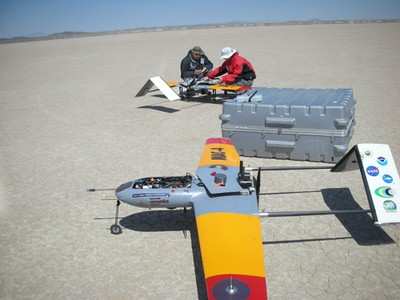
Technicians prepare the Manta for launch at Edwards AFB.

The Manta is one of several UAS produced by Advanced Ceramics Research in Tucson, AZ, now a part of BAE Systems.  Manta can carry a 15-lb payload for up to 6 hrs with a typical service altitude of 2,000-12,000 ft.  The aircraft have been deploying from NASA's Dryden Flight Research Center at Edwards AFB

Scripps researches hope to fly the system at least once a month to monitor Southern CA skies.  Future applications include real-time situational awareness during forest fires.

FMI: www.ARCTucson.com, sio.ucsd.edu

Advertisement

More News

Aero-News: Quote of the Day (12.09.25)

“We respectfully call on the City of Mesa to: 1. Withdraw the landing fee proposal immediately 2. Engage with the aviation community before making decisions that impact safet>[...]

ANN's Daily Aero-Term (12.09.25): High Speed Taxiway

High Speed Taxiway A long radius taxiway designed and provided with lighting or marking to define the path of aircraft, traveling at high speed (up to 60 knots), from the runway ce>[...]

ANN's Daily Aero-Linx (12.09.25)

Aero Linx: International Federation of Airworthiness (IFA) IFA uniquely combines together all those with responsibility for policies, principles and practices concerned with the co>[...]

NTSB Final Report: Diamond Aircraft Ind Inc DA20C1 (A1); Robinson Helicopter R44

Controller’s Expectation That VW02 Would Have Departed Sooner Led To An Inadequate Scan And Loss Of Situational Awareness Analysis: A Robinson R-44 helicopter N744AF, VW02 (V>[...]

ANN FAQ: Q&A 101

A Few Questions AND Answers To Help You Get MORE Out of ANN! 1) I forgot my password. How do I find it? 1) Easy... click here and give us your e-mail address--we'll send it to you >[...]

blog comments powered by Disqus



Advertisement

Advertisement

Podcasts

Advertisement

© 2007 - 2025 Web Development & Design by Pauli Systems, LC

