Wed, Jun 23, 2004
Simultaneous Pursuit Of Type Certifications In US, Canada
 Certification work on the four-place
Seawind amphibian has probably passed the halfway mark according to
company president, Dick Silva. The work required for a type
certificate is being pursued in Canada, with FAA approving the
steps along the way. Deliveries of completed aircraft are expected
to begin in mid 2005.
Certification work on the four-place
Seawind amphibian has probably passed the halfway mark according to
company president, Dick Silva. The work required for a type
certificate is being pursued in Canada, with FAA approving the
steps along the way. Deliveries of completed aircraft are expected
to begin in mid 2005.
Approximately three dozen people have already placed escrowed
deposits for delivery slots once the TC has been granted.
The Seawind came into existence in January 1991 as a kit
aircraft. Before suspending the kit deliveries in 2001, the company
had shipped 150 kits, of which 63 have flown. Silva had hoped to
certify the Seawind from the beginning, and like Lancair, he
eventually made the commitment to go through the FAR Part 23
process. He set up a company to certify the Seawind in 2001, hired
a staff and began work on the program in 2002. The government of
Quebec extended him considerable support for bringing his project
to St. Jean-sur-Richelieu at the north end of Lake Champlain. The
production line will remain in Canada, while marketing and sales
efforts are being handled south of the border.
Performance numbers for the kit version were so impressive that
Silva has made very few changes to the design for production. None
of the changes incorporated so far were required for certification.
The three most significant modifications to the kit design include
an enlarged canopy space, permitting more headroom to the front and
rear seats; trailing link landing gear which allows for sod or
gravel strip landings; and an escape hatch in the roof for enhanced
safety.
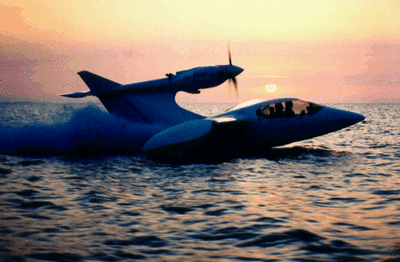
The amphibious Seawind, built of composite materials, exceeds 90
percent of all single engine aircraft in cruise speed, delivering
190 mph at 75 percent power settings. It stalls at 50 knots, climbs
at 1,250 fpm and will lift a useful load of 1,150 pounds. The
takeoff run on land requires 1,100 feet, on water it takes 1,400
feet at full gross. All of this is accomplished with a Lycoming
IO-540. While it handles in all respects like a conventional flying
boat, it looks like a space ship with its sleek, contoured
lines.
More News
Its Offerings Are Lighter, Cleaner, and Now Pushing Past 1,000nm on SAF Jet Fuel DeltaHawk’s diesel-powered aircraft lineup has seen incredible upgrades over the last few yea>[...]
The Airplane Experienced A Total Loss Of Engine Power On December 3, 2025, about 1600 central standard time, a Mooney Aircraft Corp. M20K, N57229, was substantially damaged when it>[...]
Make Sure You NEVER Miss A New Story From Aero-News Network Do you ever feel like you never see posts from a certain person or page on Facebook or Instagram? Here’s how you c>[...]
Aero Linx: European Society of Aerospace Medicine (ESAM) As a pan-European, independent forum, it works to promote the safety and health of all persons involved in aviation and spa>[...]
“We are excited to see Wisk achieve this milestone, and I’m so proud of the team that made it possible. The team at Wisk has built advanced technologies across flight c>[...]



 Aero-TV: DeltaHawks Diesel Power Steps Into the Spotlight


 See All