Sun, Nov 23, 2008
Probe Powers Down Its Ion Drive As Scheduled
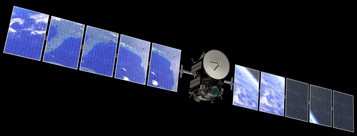
NASA's Dawn spacecraft shut down its ion propulsion system
Thursday as scheduled. The spacecraft is now gliding toward a Mars
flyby in February of next year.
"Dawn has completed the thrusting it needs to use Mars for a
gravity assist to help get us to Vesta," said Marc Rayman, Dawn's
chief engineer, of NASA's Jet Propulsion Laboratory, Pasadena, CA.
"Dawn will now coast in its orbit around the sun for the next half
a year before we again fire up the ion propulsion system to
continue our journey to the asteroid belt."
Dawn's ion engines may get a short workout next January to
provide any final orbital adjustments prior to its encounter with
the Red Planet. Ions are also scheduled to fly out of the
propulsion system during some systems testing in spring. But
mostly, Dawn's three ion engines will remain silent until June,
when they will again speed Dawn toward its first appointment, with
asteroid Vesta.
Dawn's ion engines are vital to the success of the misson's
8-year, 3-billion-mile journey to asteroid Vesta and dwarf planet
Ceres. One of these extremely frugal powerhouses can generate more
than 24 hours of thrusting while consuming about 9 ounces of the
spacecraft's xenon fuel supply -- less than the contents of a can
of soda. Over their lifetime, Dawn's three ion propulsion engines
will fire cumulatively for about 50,000 hours (over five years) --
a record for spacecraft.
Dawn will begin its exploration of asteroid Vesta in 2011 and
the dwarf planet Ceres in 2015. These two icons of the asteroid
belt have been witness to so much of our solar system's history. By
utilizing the same set of instruments at two separate destinations,
scientists can more accurately formulate comparisons and contrasts.
Dawn's science instrument suite will measure shape, surface
topography, tectonic history, elemental and mineral composition,
and will seek out water-bearing minerals. In addition, the Dawn
spacecraft itself and how it orbits both Vesta and Ceres will be
used to measure the celestial bodies' masses and gravity
fields.
The Dawn mission to asteroid Vesta and dwarf planet Ceres is
managed and operated by JPL for NASA's Science Mission Directorate,
Washington, DC.
More News
Its Offerings Are Lighter, Cleaner, and Now Pushing Past 1,000nm on SAF Jet Fuel DeltaHawk’s diesel-powered aircraft lineup has seen incredible upgrades over the last few yea>[...]
The Airplane Experienced A Total Loss Of Engine Power On December 3, 2025, about 1600 central standard time, a Mooney Aircraft Corp. M20K, N57229, was substantially damaged when it>[...]
Make Sure You NEVER Miss A New Story From Aero-News Network Do you ever feel like you never see posts from a certain person or page on Facebook or Instagram? Here’s how you c>[...]
Aero Linx: European Society of Aerospace Medicine (ESAM) As a pan-European, independent forum, it works to promote the safety and health of all persons involved in aviation and spa>[...]
“We are excited to see Wisk achieve this milestone, and I’m so proud of the team that made it possible. The team at Wisk has built advanced technologies across flight c>[...]



 Aero-TV: DeltaHawks Diesel Power Steps Into the Spotlight


 See All