
NASA, Russia To Study Effects Of Spaceflight On Small Lizards, Snails | Aero-News Network
Aero-News Network
RSS icon RSS feed
podcast icon MP3 podcast
Subscribe Aero-News e-mail Newsletter Subscribe

Airborne Unlimited -- Most Recent Daily Episodes

Episode Date

Airborne-Monday

Airborne-Tuesday

Airborne-Wednesday Airborne-Thursday

Airborne-Friday

Airborne On YouTube

Airborne-Unlimited-12.08.25

AirborneNextGen-
12.09.25

Airborne-Unlimited-12.10.25

Airborne-AffordableFlyers-12.11.25

AirborneUnlimited-12.12.25

AFE 2025 LIVE MOSAIC Town Hall (Archived): www.airborne-live.net

Wed, Sep 12, 2007

NASA, Russia To Study Effects Of Spaceflight On Small Lizards, Snails

Insurance Company Advertising Mascot Advised To Steer Clear Of Kazakhstan

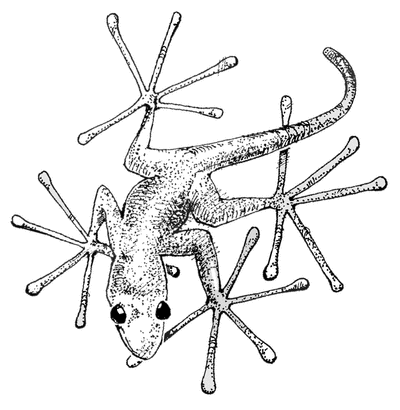
Modern science may have finally stumbled upon a way to rid the planet of the GEICO Insurance gecko, once and for all. NASA announced Tuesday it will work with Russia's space program on an upcoming mission to study the biological effects of spaceflight on some resolutely earthbound creatures.

According to NASA, the Russian Foton-M3 mission will launch from Kazakhstan this Friday, sending an automated Vostok spacecraft -- a heavily modified version of the same basic spaceship that carried Yuri Gagarin into orbit in 1961 -- into low Earth orbit for 12 days. Instead of a human astronaut, however, the small craft will hold several geckos, newts, and snails.

Scientists from NASA's Ames Research Center and Montana State University will monitor the creatures' conditions before and after the mission, measuring -- among other things -- cell growth and tissue regeneration.

NASA employees at Moffett Field, CA also developed eight one-inch-deep aluminum "attics," to house a small video camera, a solid-state recorder, infrared LEDs, a pump to provide water to the newts and geckos... and a processor to control it all.

"A team of US scientists has been invited to participate in the experiments, and our role as co-investigators will be to enhance and expand the science conducted during the mission," said Michael Skidmore, NASA's project manager for Foton-M3.

He added data collected from the upcoming mission should help validate findings from the 2005 Foton-M2 flight, also a US/Russia joint endeavor. It is hoped the findings will advance humanity's knowledge of the effects of gravity on all life on Earth.

"NASA's long-term goal is to use simple, easily maintained species to determine the biological responses to the rigors of spaceflight, including the virtual absence of gravity," said Kenneth Souza, the project scientist at NASA Ames.

FMI: www.nasa.gov

Advertisement

More News

Aero-News: Quote of the Day (12.11.25)

"The owners envisioned something modern and distinctive, yet deeply meaningful. We collaborated closely to refine the flag design so it complemented the aircraft’s contours w>[...]

ANN's Daily Aero-Term (12.11.25): Nonradar Arrival

Nonradar Arrival An aircraft arriving at an airport without radar service or at an airport served by a radar facility and radar contact has not been established or has been termina>[...]

Classic Aero-TV: David Uhl and the Lofty Art of Aircraft Portraiture

From 2022 (YouTube Edition): Still Life with Verve David Uhl was born into a family of engineers and artists—a backdrop conducive to his gleaning a keen appreciation for the >[...]

Airborne-NextGen 12.09.25: Amazon Crash, China Rocket Accident, UAV Black Hawk

Also: Electra Goes Military, Miami Air Taxi, Hypersonics Lab, MagniX HeliStrom Amazon’s Prime Air drones are back in the spotlight after one of its newest MK30 delivery drone>[...]

Airborne 12.05.25: Thunderbird Ejects, Lost Air india 737, Dynon Update

Also: Trailblazing Aviator Betty Stewart, Wind Farm Scrutiny, Chatham Ban Overturned, Airbus Shares Dive A Thunderbird pilot, ID'ed alternately as Thunderbird 5 or Thunderbird 6, (>[...]

blog comments powered by Disqus



Advertisement

Advertisement

Podcasts

Advertisement

© 2007 - 2025 Web Development & Design by Pauli Systems, LC

