'Supersonic Jousting,' Anyone?
 Early fighter pilots
were sometimes called knights of the air, a reflection of medieval
times when knights used blunted lances in jousting tournaments to
dismount competitors from their horses. Now, jet-borne jousting is
combating supersonic shockwaves, hopefully enough to lessen the
resulting sonic boom heard on the ground.
Early fighter pilots
were sometimes called knights of the air, a reflection of medieval
times when knights used blunted lances in jousting tournaments to
dismount competitors from their horses. Now, jet-borne jousting is
combating supersonic shockwaves, hopefully enough to lessen the
resulting sonic boom heard on the ground.
Gulfstream Aerospace and NASA's Dryden Flight Research Center
have teamed in a project called Quiet Spike to investigate the
suppression of sonic booms.
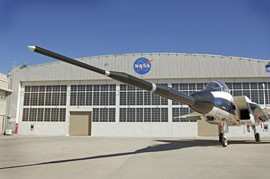
The project centers around a retractable, 24-foot-long
lance-like spike mounted on the nose of NASA Dryden's F-15B
research testbed aircraft. The spike, made of composite materials,
creates three small shock waves that travel parallel to each other
all the way to the ground, producing less noise than typical shock
waves that build up at the front of supersonic jets.
Before flying with the giant spike (shown extended at right),
NASA Dryden engineers and technicians, working alongside their
Gulfstream counterparts, mounted it on the aircraft and conducted
various structural tests on the ground.
 "The partnership
between Gulfstream and Dryden during Quiet Spike installation and
ground testing on the F-15B has produced a wealth of valuable
information. The duration of this flight test effort will prove to
be exciting and informative for everyone involved," said Leslie
Molzahn, NASA Dryden's operations engineer on the project.
"The partnership
between Gulfstream and Dryden during Quiet Spike installation and
ground testing on the F-15B has produced a wealth of valuable
information. The duration of this flight test effort will prove to
be exciting and informative for everyone involved," said Leslie
Molzahn, NASA Dryden's operations engineer on the project.
Since the project's first flight, conducted on Aug. 10, 2006,
several more flights have put the system's structural integrity to
the test before moving on to sonic boom suppression measurements.
While these tests won't actually 'quiet' the F-15's sonic boom,
they will show that the spike's design is capable of use in a real
flight environment. The flights are monitored in NASA Dryden's
mission control.
"Working with Gulfstream has provided a significant advantage to
this flight research project," NASA project manager Michael
Toberman says. "This project merges Gulfstream's manufacturing
expertise with NASA Dryden's flight test expertise."
Shockwaves develop around aircraft as they near Mach 1, or about
760 mph, the speed of sound at sea level. When an aircraft travels
supersonically, the resulting shockwaves can produce a loud sonic
boom that rattles windows and nerves on the ground under the path
of the supersonic jet.
Because of sonic boom intensity, the Federal Aviation
Administration prohibits supersonic flight over land, except in
special military flight corridors.
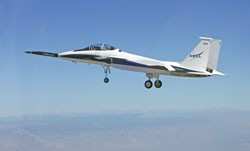 Gulfstream's Quiet
Spike puts spike-induced sonic boom suppression theory to the test
in the actual flight environment afforded by NASA's supersonic
F-15B. The aircraft has served NASA and industry in this role for
years as a flying wind tunnel and supersonic testbed vehicle.
Gulfstream's Quiet
Spike puts spike-induced sonic boom suppression theory to the test
in the actual flight environment afforded by NASA's supersonic
F-15B. The aircraft has served NASA and industry in this role for
years as a flying wind tunnel and supersonic testbed vehicle.
Once the Quiet Spike has proven to be structurally sound, it can
be incorporated with confidence onto advanced low-boom
configuration aircraft to further lessen the impact of sonic
booms.
"By changing length in-flight, Quiet Spike will demonstrate yet
another way to shape the sonic boom," said Gulfstream spokesman
Robert Baugniet. "It's a necessary step toward low boom aircraft
design and truly quieting the sonic boom."
In 2003 and 2004, NASA Dryden worked with DARPA and Northrop
Grumman on the Shaped Sonic Boom Demonstration project, which flew
a highly modified F-5 aircraft to prove that aircraft shaping can
reduce sonic boom intensity.
(ANN thanks Gray Creech, NASA Dryden Flight Research Center
Public Affairs)



 ANN's Daily Aero-Linx (12.12.25)


 See All