
Dawn Delivers New Image Of Ceres | Aero-News Network
Aero-News Network
RSS icon RSS feed
podcast icon MP3 podcast
Subscribe Aero-News e-mail Newsletter Subscribe

Airborne Unlimited -- Most Recent Daily Episodes

Episode Date

Airborne-Monday

Airborne-Tuesday

Airborne-Wednesday Airborne-Thursday

Airborne-Friday

Airborne On YouTube

Airborne-Unlimited-12.08.25

AirborneNextGen-
12.09.25

Airborne-Unlimited-12.10.25

Airborne-AffordableFlyers-12.11.25

AirborneUnlimited-12.12.25

AFE 2025 LIVE MOSAIC Town Hall (Archived): www.airborne-live.net

Mon, Jan 26, 2015

Dawn Delivers New Image Of Ceres

Clearer Photos Returning To Earth As Spacecraft Nears Dwarf Planet

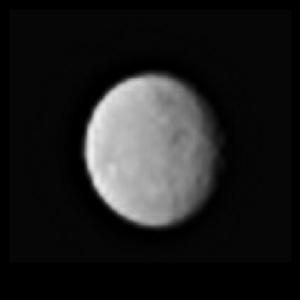
As NASA's Dawn spacecraft closes in on Ceres, new images show the dwarf planet at 27 pixels across, about three times better than the calibration images taken in early December. These are the first in a series of images that will be taken for navigation purposes during the approach to Ceres.

Over the next several weeks, Dawn will deliver increasingly better and better images of the dwarf planet, leading up to the spacecraft's capture into orbit around Ceres on March 6. The images will continue to improve as the spacecraft spirals closer to the surface during its 16-month study of the dwarf planet.

"We know so much about the solar system and yet so little about dwarf planet Ceres. Now, Dawn is ready to change that," said Marc Rayman, Dawn's chief engineer and mission director, based at NASA's Jet Propulsion Laboratory in Pasadena, California.

The best images of Ceres so far were taken by NASA's Hubble Space Telescope in 2003 and 2004. This most recent images from Dawn, taken January 13, 2015, at about 80 percent of Hubble resolution, are not quite as sharp. But Dawn's images will surpass Hubble's resolution at the next imaging opportunity, which will be at the end of January. “Already, the (latest) images hint at first surface structures such as craters," said Andreas Nathues, lead investigator for the framing camera team at the Max Planck Institute for Solar System Research, Gottingen, Germany.

Ceres is the largest body in the main asteroid belt, which lies between Mars and Jupiter. It has an average diameter of 590 miles, and is thought to contain a large amount of ice. Some scientists think it's possible that the surface conceals an ocean.

Dawn's arrival at Ceres will mark the first time a spacecraft has ever visited a dwarf planet. "The team is very excited to examine the surface of Ceres in never-before-seen detail," said Chris Russell, principal investigator for the Dawn mission, based at the University of California, Los Angeles. "We look forward to the surprises this mysterious world may bring."

The spacecraft has already delivered more than 30,000 images and many insights about Vesta, the second most massive body in the asteroid belt. Dawn orbited Vesta, which has an average diameter of 326 miles from 2011 to 2012. Thanks to its ion propulsion system, Dawn is the first spacecraft ever targeted to orbit two deep-space destinations.

(Image provided by NASA)

FMI: www.nasa.gov

Advertisement

More News

ANN's Daily Aero-Linx (12.12.25)

Aero Linx: Commercial Aviation Safety Team (CAST) Founded in 1997, the Commercial Aviation Safety Team (USCAST) has developed an integrated, data-driven strategy to reduce the comm>[...]

ANN's Daily Aero-Term (12.12.25): Land And Hold Short Operations

Land And Hold Short Operations Operations that include simultaneous takeoffs and landings and/or simultaneous landings when a landing aircraft is able and is instructed by the cont>[...]

ANN FAQ: How Do I Become A News Spy?

We're Everywhere... Thanks To You! Even with the vast resources and incredibly far-reaching scope of the Aero-News Network, every now and then a story that should be reported on sl>[...]

NTSB Final Report: Cirrus Design Corp SF50

Pilot’s Inadvertent Use Of The Landing Gear Control Handle Instead Of The Flaps Selector Switch During The Landing Rollout Analysis: The pilot reported that during the landin>[...]

Airborne 12.08.25: Samaritan’s Purse Hijack, FAA Med Relief, China Rocket Fail

Also: Cosmonaut Kicked Out, Airbus Scales Back, AF Silver Star, Russian A-60 Clobbered A Samaritan’s Purse humanitarian flight was hijacked on Tuesday, December 2, while atte>[...]

blog comments powered by Disqus



Advertisement

Advertisement

Podcasts

Advertisement

© 2007 - 2025 Web Development & Design by Pauli Systems, LC

