Sun, May 07, 2023
Expected Release Date Slides by 3 Years After Continued Ejection Seat Problems
The T-7A Red Hawk jet trainer won't be expected to reach initial operational capability until spring of 2027 according to an Air Force release.
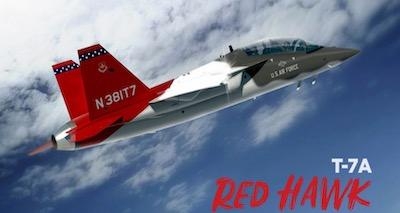
The aircraft was supposed to be the next-generation replacement for the long-in-the-tooth, but venerable, T-38 Talon. The T-X, as it was initially known, was hurriedly propositioned to replace the aged and increasingly weary Talons after more than 6 decades of service. When slated for adoption, the Air Force planned to have the Red Hawk in service in FY 2020. Budgets and politics got in the way, and its priority slid throughout the twenty-teens, culminating in the first production aircraft rolling off the line in late April of 2022.
No new aircraft is without its teething issues, and the T-7 appears to be no exception. Problems with the escape system and ejection process continued to grate against deadlines, with first deliveries from Boeing expected to take place sometime in December 2025. USAF acquisition chief Andrew Hunter told reporters that the T-7 isn't slated to hit IOC until 2027, with current ground evaluation focused on sled-testing before moving on to taxi tests. Despite watching what was once supposed to be a fairly high priority program for the Air Force - remember, airmen have died from fatigue failures in the T-38 Talon - the program continues to move at a meandering government pace. Perhaps most at fault is Boeing, however, working with Saab on their joint T-X program.
Currently, the bugbear of the T-7 lies in its problems with allowing a safe escape from an imperiled aircraft. While it was designed to accommodate a wider range of body types and pilot demographics, ejecting pilots risk high-speed concussions and a perilous amount of acceleration on ignition, all capped off by an equally dangerous deceleration when their parachute deploys. Once ready, the service expects to replace more than 500 of its T-38s with more than 350 T-7s - whenever it's ready, at least.
More News
Its Offerings Are Lighter, Cleaner, and Now Pushing Past 1,000nm on SAF Jet Fuel DeltaHawk’s diesel-powered aircraft lineup has seen incredible upgrades over the last few yea>[...]
The Airplane Experienced A Total Loss Of Engine Power On December 3, 2025, about 1600 central standard time, a Mooney Aircraft Corp. M20K, N57229, was substantially damaged when it>[...]
Make Sure You NEVER Miss A New Story From Aero-News Network Do you ever feel like you never see posts from a certain person or page on Facebook or Instagram? Here’s how you c>[...]
Aero Linx: European Society of Aerospace Medicine (ESAM) As a pan-European, independent forum, it works to promote the safety and health of all persons involved in aviation and spa>[...]
“We are excited to see Wisk achieve this milestone, and I’m so proud of the team that made it possible. The team at Wisk has built advanced technologies across flight c>[...]



 Aero-TV: DeltaHawks Diesel Power Steps Into the Spotlight


 See All