
DARPA Hypersonic Vehicle Advances Technical Knowledge | Aero-News Network
Aero-News Network
RSS icon RSS feed
podcast icon MP3 podcast
Subscribe Aero-News e-mail Newsletter Subscribe

Airborne Unlimited -- Most Recent Daily Episodes

Episode Date

Airborne-Monday

Airborne-Tuesday

Airborne-Wednesday Airborne-Thursday

Airborne-Friday

Airborne On YouTube

Airborne-SpecialEpisode-12.15.25

AirborneNextGen-
12.16.25

Airborne-Unlimited-12.10.25

Airborne-AffordableFlyers-12.11.25

AirborneUnlimited-12.12.25

AFE 2025 LIVE MOSAIC Town Hall (Archived): www.airborne-live.net

Sat, Aug 13, 2011

DARPA Hypersonic Vehicle Advances Technical Knowledge

HTV-2 Collects Unique Data During Several Phases Of Second Flight

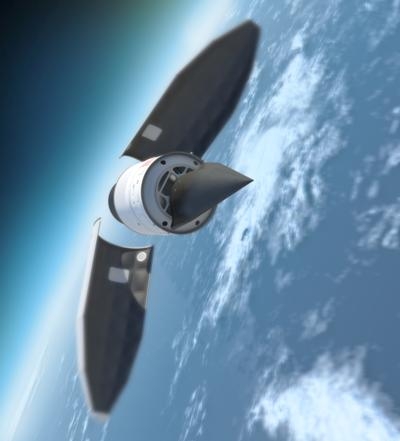
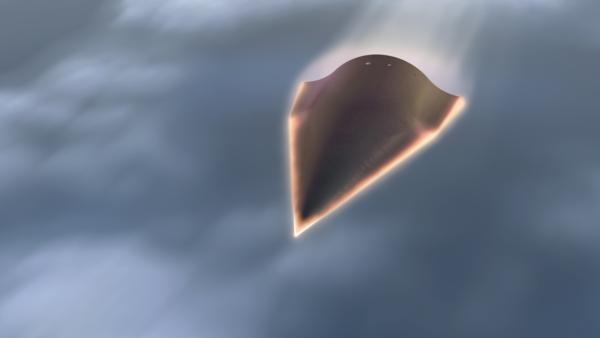
DARPA attempted for the second time to fly the fastest aircraft ever built Thursday. The Agency's Falcon Hypersonic Technology Vehicle 2 (HTV-2) is designed to fly anywhere in the world in less than 60 minutes. This capability requires an aircraft that can fly at 13,000 mph, while experiencing temperatures in excess of 3500F. The second test flight began with launch at 0745 Pacific Time.

During Thursday's test flight, the Minotaur IV vehicle successfully inserted the aircraft into the desired trajectory. Separation of the vehicle was confirmed by rocket cam and the aircraft transitioned to Mach 20 aerodynamic flight. This transition represents a critical knowledge and control point in maneuvering atmospheric hypersonic flight. More than nine minutes of data was collected before an anomaly caused loss of signal. Initial indications are that the aircraft impacted the Pacific Ocean along the planned flight path.

"Here's what we know," said Air Force Maj. Chris Schulz, DARPA HTV-2 program manager and PhD in aerospace engineering. "We know how to boost the aircraft to near space. We know how to insert the aircraft into atmospheric hypersonic flight. We do not yet know how to achieve the desired control during the aerodynamic phase of flight. It's vexing; I'm confident there is a solution. We have to find it."

"Prior to flight, the technical team completed the most sophisticated simulations and extensive wind tunnel tests possible. But these ground tests have not yielded the necessary knowledge. Filling the gaps in our understanding of hypersonic flight in this demanding regime requires that we be willing to fly," said DARPA Director Regina Dugan. "In the April 2010 test, we obtained four times the amount of data previously available at these speeds. Today more than 20 air, land, sea and space data collection systems were operational. We'll learn. We'll try again. That's what it takes."

According to Schulz, three technical challenges exist within this HTV-2 flight regime. They are categorized as aerodynamic; aerothermal; and guidance, navigation and control. And each phase of flight introduces unique obstacles within these areas. "To address these obstacles, DARPA has assembled a team of experts that will analyze the flight data collected during today's test flight, expanding our technical understanding of this incredibly harsh flight regime," explained Schulz. "As today's flight indicates, high-Mach flight in the atmosphere is virtually uncharted territory. "

In the coming weeks, the assembled independent Engineering Review Board will review and analyze the data collected. This data will inform policy, acquisition and operational decisions for future Conventional Prompt Global Strike programs-the goal of which, ultimately, is to have the capability to reach anywhere in the world in less than one hour.

FMI: www.darpa.mil

Advertisement

More News

ANN's Daily Aero-Term (12.19.25): Ultrahigh Frequency (UHF)

Ultrahigh Frequency (UHF) The frequency band between 300 and 3,000 MHz. The bank of radio frequencies used for military air/ground voice communications. In some instances this may >[...]

NTSB Prelim: Cirrus Design Corp SR22T

During The 7 Second Descent, There Was Another TAWS Alert At Which Time The Engine Remained At Full Power On October 24, 2025 at 2115 mountain daylight time, a Cirrus SR22T, N740TS>[...]

Classic Aero-TV: The Red Tail Project--Carrying the Torch of the Tuskegee Airmen

From 2009 (YouTube Edition): Educational Organization Aims to Inspire by Sharing Tuskegee Story Founding leader Don Hinz summarized the Red Tail Project’s mission in simple, >[...]

Aero-News: Quote of the Day (12.19.25)

“This feels like an important step since space travel for people with disabilities is still in its very early days... I’m so thankful and hope it inspires a change in m>[...]

Airborne 12.17.25: Skydiver Hooks Tail, Cooper Rotax Mount, NTSB v NDAA

Also: New Katanas, Kern County FD Training, IndiGo’s Botched Roster, MGen. Leavitt Named ERAU Dean The Australian Transportation Safety Bureau (ATSB) has wrapped up its inves>[...]

blog comments powered by Disqus



Advertisement

Advertisement

Podcasts

Advertisement

© 2007 - 2025 Web Development & Design by Pauli Systems, LC

