Savings At Nellis AFB Estimated At $38,000 Per Month
 A solar-energy array at Nellis Air
Force Base, Nevada, is saving money for the Air Force and
decreasing the service's reliance on fossil fuels. "The military,
perhaps better than anyone, is bound and determined to be good
stewards of the incredible natural resources we have in this
country," said Air Force Col. Dave Belote, commander of the 99th
Air Base Wing at Nellis, in an October 8th interview on the
Pentagon Channel podcast "Armed with Science: Research and
Applications for the Modern Military."
A solar-energy array at Nellis Air
Force Base, Nevada, is saving money for the Air Force and
decreasing the service's reliance on fossil fuels. "The military,
perhaps better than anyone, is bound and determined to be good
stewards of the incredible natural resources we have in this
country," said Air Force Col. Dave Belote, commander of the 99th
Air Base Wing at Nellis, in an October 8th interview on the
Pentagon Channel podcast "Armed with Science: Research and
Applications for the Modern Military."
The solar array, which debuted as North America's largest
renewable venture in December 2007, is composed of more than 72,000
solar panels containing 6 million solar cells, and represents an
enormous step toward energy efficiency, Belote said. It supplies 28
percent of the base's power, saving about $83,000 a month and
24,000 tons of carbon dioxide emissions a year, the colonel said.
"It's really an exciting thing to be a part of," he added.
The photovoltaic system uses some of the same technology
pioneered in the mid-1960s by the Bell Corp. It produces power only
while the sun is shining. "We are peak producing at about noon to 1
p.m.," Belote said.
The array's solar panels are produced and supplied by four
companies, the colonel said, and officials have been keeping data
on which are most effective. Data-collecting devices on the grid
report real-time system performance information to each of the four
companies and the main corporation. That information has led one of
the companies to start creating a more energy-efficient bifacial
solar panel after seeing the added efficiency was worth the
cost.
The panels are located in an industrial portion of the base and
are designed to absorb and convert sunlight, as opposed to
reflecting it, so they do not interfere with the base's flying
mission, Belote said. Of the 140 acres of land used for the array,
33 acres are a capped-off landfill. "We couldn't have done anything
else with it," he said, "and saved millions of dollars in
environmental clean-up and made use of land that would not be used
at all otherwise."
In its two years of operation, the array has posed no problems,
the colonel said. "One of the most pleasant surprises about this
array and this climate has been the virtual total lack of
maintenance," he said. Solar panels usually present a challenge, he
noted, because they need to be kept clean. "As soot and grime coat
the panels, efficiency drops off pretty quickly," he explained. But
because of the desert climate, the panels at Nellis have yet to
require cleaning.
Belote said he has been in contact with other Air Force leaders
interested in similar projects, and has addressed many groups about
involving the military in these types of environmental
partnerships. He also had the opportunity to speak with President
Barack Obama when the president visited the base in May, and he
said Obama graciously accepted his suggestions and encouraged him
to continue working on these issues and partnerships.
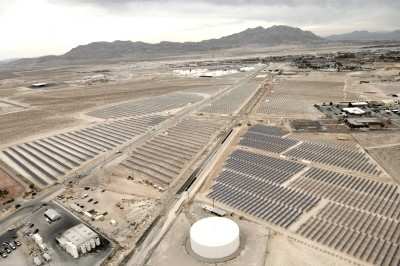
Air Force Photo
"Because the [Defense Department] trumpets the fact that it
knows it is the nation's largest consumer of energy, and the Air
Force within [the Defense Department] is the largest consumer of
energy, we are all about finding ways to stop spending money on
fossil fuels," he said. "We would like to use clean, renewable
projects anywhere possible."
Energy saving projects like this allow the Air Force to be
fiscally responsible, he added, and "allows us to be great stewards
in natural resources."



 Aero-News: Quote of the Day (12.11.25)


 See All