

NASA's MESSENGER Spacecraft Returns To Mercury | Aero-News Network
Aero-News Network
RSS icon RSS feed
podcast icon MP3 podcast
Subscribe Aero-News e-mail Newsletter Subscribe

Airborne Unlimited -- Most Recent Daily Episodes

Episode Date

Airborne-Monday

Airborne-Tuesday

Airborne-Wednesday Airborne-Thursday

Airborne-Friday

Airborne On YouTube

Airborne-Unlimited-12.01.25

AirborneNextGen-
12.02.25

Airborne-Unlimited-11.19.25

Airborne-AffordableFlyers-11.20.25

AirborneUnlimited-11.21.25

LIVE MOSAIC Town Hall (Archived): www.airborne-live.net

Fri, Oct 03, 2008

NASA's MESSENGER Spacecraft Returns To Mercury

Second Of Three Flybys Coming Early Next Week

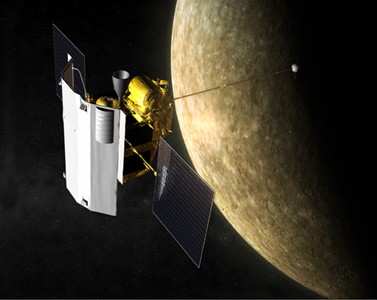
A NASA spacecraft will conduct the second of three flybys of Mercury on October 6 to photograph most of its remaining unseen surface and collect science data.

The Mercury Surface, Space Environment, Geochemistry, and Ranging, or MESSENGER, spacecraft will pass 125 miles above the planet's cratered surface, taking more than 1200 pictures. The flyby also will provide a critical gravity assist needed for the probe to become, in March 2011, the first spacecraft to orbit Mercury.

"The results from MESSENGER's first flyby of Mercury resolved debates that are more than 30 years old," said Sean C. Solomon, the mission's principal investigator from the Carnegie Institution of Washington. "This second encounter will uncover even more information about the planet."

During the spacecraft's first flyby on January 14, its cameras returned images of approximately 20 percent of Mercury's surface never before seen by space probes. Images showed that volcanic eruptions produced many of Mercury's plains, its magnetic field appears to be actively generated in a molten iron core, and the planet has contracted more than previously thought.

"This second flyby will show us a completely new area of Mercury's surface, opposite from the side of the planet we saw during the first," said Louise M. Prockter, instrument scientist for the spacecraft's Mercury Dual Imaging System at the Johns Hopkins University Applied Physics Laboratory, or APL, in Laurel, Md.

NASA says the second flyby is expected to yield more surprises about the unique physical processes governing Mercury's atmosphere, as well as additional information about the charged particles located in and around Mercury's dynamic magnetic field. An altimeter on the spacecraft will measure the planet's topography, allowing scientists, for the first time, to correlate high-resolution topography measurements with high-resolution images.

A major goal of the orbital phase of the mission is to determine the composition of Mercury's surface. Instruments designed to make those measurements will get another peek at Mercury during this flyby.

"We will be able to do the first test of differences in the chemical compositions between the two hemispheres viewed in the two flybys," said Ralph McNutt, the mission's project scientist at APL. "Instruments also will provide information about portions of Mercury's surface in unprecedented detail."

The spacecraft is more than halfway through a 4.9-billion-mile journey to enter orbit around Mercury that includes more than 15 trips around the sun. In addition to flying by Mercury, the spacecraft flew past Earth in August 2005 and past Venus in October 2006 and June 2007.

The project is the seventh in NASA's Discovery Program of low-cost, scientifically focused space missions. The spacecraft was designed and built by APL. The mission also is managed and operated by APL for NASA's Science Mission Directorate in Washington.

FMI: www.nasa.gov/messenger

Advertisement

More News

NTSB Prelim: Cirrus Design Corp SR20

The Airplane Made An Uncommanded Right Yaw And Roll, And He Was Unable To Maintain Control Of The Airplane On November 11, 2025, about 1750 central standard time, a Cirrus SR20, N8>[...]

ANN's Daily Aero-Linx (11.30.25)

Aero Linx: Florida Antique Biplane Association "Biplanes.....outrageous fun since 1903." That quote really defines what the Florida Antique Biplane Association (FABA) is all about.>[...]

ANN's Daily Aero-Term (11.30.25): Wind Shear Escape

Wind Shear Escape An unplanned abortive maneuver initiated by the pilot in command (PIC) as a result of onboard cockpit systems. Wind shear escapes are characterized by maximum thr>[...]

Aero-News: Quote of the Day (11.30.25)

“Working closely with the Polish Armed Forces, we’re focused on disciplined execution to help enhance Poland’s defense capabilities and keep up with the strong de>[...]

Airborne 11.26.25: Bonanza-Baron Fini, Archer v LA NIMBYs, Gogo Loses$$$

Also: Bell 505 on SAF, NYPA Gets Flak For BizAv 'Abuse', FAA Venezuela Caution, Horizon Update Textron Aviation has confirmed it will be ending production of the Beechcraft Bonanza>[...]

blog comments powered by Disqus



Advertisement

Advertisement

Podcasts

Advertisement

© 2007 - 2025 Web Development & Design by Pauli Systems, LC

