
Dropcopter Releases Pollination Results | Aero-News Network
Aero-News Network
RSS icon RSS feed
podcast icon MP3 podcast
Subscribe Aero-News e-mail Newsletter Subscribe

Airborne Unlimited -- Most Recent Daily Episodes

Episode Date

Airborne-Monday

Airborne-Tuesday

Airborne-Wednesday Airborne-Thursday

Airborne-Friday

Airborne On YouTube

Airborne-Unlimited-12.08.25

AirborneNextGen-
12.09.25

Airborne-Unlimited-12.10.25

Airborne-FltTraining-12.04.25

AirborneUnlimited-12.05.25

AFE 2025 LIVE MOSAIC Town Hall (Archived): www.airborne-live.net

Mon, Jul 09, 2018

Dropcopter Releases Pollination Results

Assists In Agricultural Pollination During Cold Weather And Bee Shortages

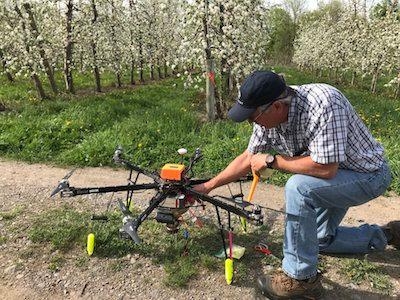
Agricultural drone startup company Dropcopter, which is based in California and Central New York, recently made headlines as the first company to successfully pollinate almonds, cherries and apples using drones.

The company, a partnership between Matt Koball, Mike Winch and Adam Fine has been conducting studies on supplemental drone pollination since 2015. The company this week released results from its 2018 third party, studies which report a massive increase in almonds and cherries as well as surprising developments for apples.

Depending on environmental conditions which dictate the effectiveness of bees, the company has demonstrated an effective increase of 25% to 60% pollination set (cherries and almonds). It means that in cold weather, and during bee shortages there’s a viable alternative to dependency on insect pollination.

Their recently publicized Apple trials are a more complex but intriguing result. Apples are not grown in the same way that almonds are. If an apple orchard sets too much fruit, it requires the grower to hand thin the less desirable apples. That’s a significant increase in labor cost. The reason for this is that the first and largest blooms to open on an apple tree produce the most desirable and largest fruit. The smaller, secondary blooms produce smaller, less desirable fruit that are less valuable in the marketplace.

What Dropcopter’s controlled Apple trial has shown is that the artificial cross-pollination of these “King blooms” has increased the size (diameter) of the crop to be harvested. Bigger fruit equals better price.

Using Dropcopter’s methods a farmer can ensure that these “King blooms” are pollinated as soon as they open. A farmer can effectively “dial-in” the amount of pollination, maximizing their sizing to get the greatest return for their crop.

(Image provided with Dropcopter news release)

FMI: dropcopter.com

Advertisement

More News

Aero-News: Quote of the Day (12.07.25)

“This vote sends an undeniable message to Air Transat management: We are unified, resolute, and have earned a contract that reflects today’s industry standards, not the>[...]

ANN's Daily Aero-Linx (12.07.25)

Aero Linx: Beech Aero Club The Beech Aero Club (BAC) is the international type club for owners and pilots of the Beech Musketeer aircraft and its derivatives, the Sport, Super, Sun>[...]

NTSB Final Report: Lafferty Jack Sea Rey

While Landing In The River, The Extended Landing Gear Contacted The Water And The Airplane Nosed Over, Resulting In Substantial Damage Analysis: The pilot of the amphibious airplan>[...]

Classic Aero-TV: The B29 SuperFortress ‘Doc’ - History in Flight

From 2022 (YouTube Edition): Carrying the Legacy of The B-29 For Generations to Come We had a chance to chat with the Executive Director of B-29 Doc, Josh Wells, during their stop >[...]

Airborne 12.08.25: Samaritan’s Purse Hijack, FAA Med Relief, China Rocket Fail

Also: Cosmonaut Kicked Out, Airbus Scales Back, AF Silver Star, Russian A-60 Clobbered A Samaritan’s Purse humanitarian flight was hijacked on Tuesday, December 2, while atte>[...]

blog comments powered by Disqus



Advertisement

Advertisement

Podcasts

Advertisement

© 2007 - 2025 Web Development & Design by Pauli Systems, LC

