Pre-Rollout Statement Sheds Light on Classified Bomber Program
Days before the U.S. Air Force’s first B-21 Raider strategic bomber is slated to emerge from Northrop Grumman’s Palmdale, California factory, the storied firm founded by Jack Northrop—aerospace pioneer and namesake of the giant tailless pterosaur Quetzalcoatlus northropi—revealed formerly clandestine details about the highly-classified bomber program.
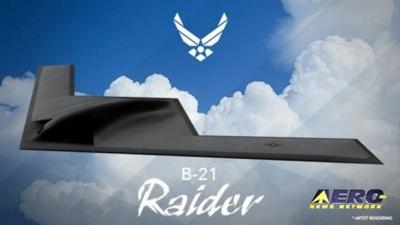
In a 29 November statement, Northrop Grumman confided: The bomber “has … been designed as the lead component of a larger family of systems that will deliver intelligence, surveillance and reconnaissance (ISR), electronic attack and multi-domain networking capabilities.”
The statement confirmed that the B-21 will rely on external support platforms or systems; although whether these are escort aircraft, bomber-launched vehicles, satellites, or some other technology remains unclear. In recent months, USAF officials have begun describing the B-21 as an ISR node deep within enemy-controlled airspace.
Air Force Secretary Frank Kendall recently announced he was abandoning plans to develop autonomous, long-range, collaborative combat aircraft meant to escort the B-21 deep into enemy territory. Kendall’s announcement did not, however, rule out possibilities the likes of the bomber launching decoys, jamming vehicles, or ISR-collecting drones.
Northrop Grumman maintains it has successfully demonstrated migration of B-21 ground systems data to “a cloud environment.” Subject demonstration included “the B-21 digital twin, that will support B-21 operations and sustainment. This robust cloud-based digital infrastructure will result in a more maintainable and sustainable aircraft with lower-cost infrastructure.”
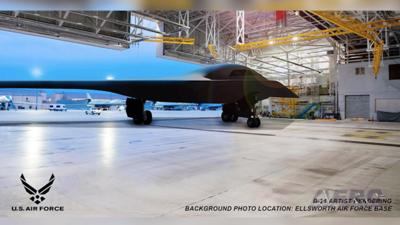
A digital twin is a finely detailed digital model of a system that allows changes—and their ramifications—to be explored by engineers with far greater fidelity and speed than older design and development technologies allowed.
Northrop Grumman alleged the B-21’s open architecture will preclude the pattern of block upgrades characteristic of legacy military aircraft.
“To meet the evolving threat environment, the B-21 has been designed from day one for rapid upgradeability,” the company said. “Unlike earlier generation aircraft, the B-21 will not undergo block upgrades. New technology, capabilities and weapons will be seamlessly incorporated through agile software upgrades and built-in hardware flexibility. This will ensure the B-21 Raider can continuously meet the evolving threat head on for decades to come.”
Northrop Grumman added that, as a “digital bomber,” the B-21 “uses agile software development, advanced manufacturing techniques, and digital engineering tools to help mitigate production risk” and “enable modern sustainment practices.”
The company explained that maintainability was set as “an equally important requirement to stealth performance” at the beginning of the program; and “long-term operations and sustainment affordability [have] been a B-21 program priority from the start.” Working collaboratively on maintainability with the Air Force, the company said it’s “driving more affordable, predictable operations and sustainment outcomes.”
Northrop Grumman has described the B-21 as a “sixth-generation” aircraft—a term which has yet to be clearly defined. Fifth-generation aircraft employ a high degree of stealth and sensor fusion for high degrees of situational awareness. How and to what extent sixth-generation aircraft might improve on their forebears’ combat effectiveness remains to be seen.
Various descriptions of “sixth generation” being bandied about the defense industry suggest such aircraft would feature “optionally manned” capability—which the B-21 is meant to have—better situational awareness, better stealth, and potential use of directed-energy weapons—among other possible attributes.
Of stealth, Northrop Grumman set forth that it’s applying “continuously advancing technology, employing new manufacturing techniques and materials to ensure the B-21 will defeat the anti-access, area-denial systems it will face.”
The B-21 “benefits from more than three decades of strike and stealth technology,” the company avers, referring to its work on the B-2 Spirit bomber, the YF-23 fighter prototype, the Tacit Blue stealth demonstrator and F-117 antecedent, the AGM-137 Tri-Service Standoff Missile, and presumed numerous classified programs.
“It is the next evolution of the Air Force strategic bomber fleet,” Northrop Grumman declared of the B-21, calling the aircraft a “visible and flexible deterrent.”

Calling the B-21 the “backbone of the future for U.S. airpower,” Northrop Grumman said the aircraft will “deliver a new era of capability and flexibility through advanced integration of data, sensors and weapons. Capable of delivering both conventional and nuclear payloads, the B-21 will be one of the most effective aircraft in the sky, with the ability to use a broad mix of stand-off and direct attack munitions.”
The company noted that the B-21 was named “Raider” to commemorate the B-25 Doolittle raiders that bombed Japan early in WWII. “The actions of these eighty volunteers were instrumental in shifting momentum in the Pacific theater,” and the mission served as a “catalyst to a multitude” of future achievements “in U.S. air superiority from land or sea.”
The B-21 is due to roll out of Plant 42 on 02 December, with its first flight conditionally scheduled in mid-2023.



 ANN's Daily Aero-Term (11.28.25): Unmanned Aircraft System (UAS)


 See All