
Space Station Crew Lands With Olympic Torch | Aero-News Network
Aero-News Network
RSS icon RSS feed
podcast icon MP3 podcast
Subscribe Aero-News e-mail Newsletter Subscribe

Airborne Unlimited -- Most Recent Daily Episodes

Episode Date

Airborne-Monday

Airborne-Tuesday

Airborne-Wednesday Airborne-Thursday

Airborne-Friday

Airborne On YouTube

Airborne-Unlimited-12.08.25

AirborneNextGen-
12.09.25

Airborne-Unlimited-12.10.25

Airborne-AffordableFlyers-12.11.25

AirborneUnlimited-12.12.25

AFE 2025 LIVE MOSAIC Town Hall (Archived): www.airborne-live.net

Tue, Nov 12, 2013

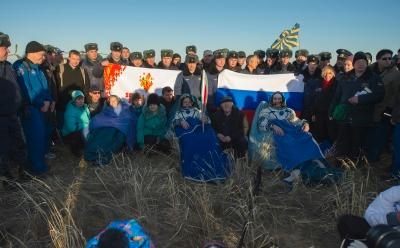
Space Station Crew Lands With Olympic Torch

Expedition 37 Crew Lands In Kazakhstan After 166 Days in Space

Expedition 37 crew members Karen Nyberg of NASA, Fyodor Yurchikhin of the Russian Federal Space Agency and Luca Parmitano of the European Space Agency have returned to Earth from the International Space Station, landing at 2149 EST Sunday, Nov. 10 (8:49 a.m. Kazakhstan time, Nov. 11), after spending 166 days in space.

Inside the Soyuz spacecraft carrying the astronauts was the Olympic torch, which was launched to the station Nov. 6 and taken on a spacewalk Saturday as part of the torch relay. The torch will be used to light the Olympic flame at the Fisht Stadium in Sochi, Russia, marking the start of the 2014 Winter Games in February.

Nyberg, Parmitano and Yurchikhin arrived at the station in May, and during their extended stay in space orbited Earth 2,656 times and traveled more than 70 million miles. Parmitano conducted a spacewalk in July, becoming the first Italian to walk in space. The crew welcomed Orbital Sciences Corp.'s Cygnus cargo spacecraft during its demonstration mission to the station. The trio spent hundreds of hours conducting fundamental research in areas such as human biology, life sciences, physical sciences, Earth sciences, astrophysics and technology research.

Yurchikhin now has logged 537 days in space, spanning four spaceflights. This puts him 12th on the all-time endurance list. Nyberg has accumulated 180 days in space over two missions. This was Parmitano's first mission.

The crew performed research into how plants grow, which may lead to more efficient crops on Earth and improve understanding of how future crews could grow their own food in space. They tested a new portable gas monitor designed to help analyze the environment inside the space station and continued fuel and combustion experiments undertaken by past crews. The crew also collected data and samples that will be used to help scientists understand ocular health issues of space station crew members and understand changes to body measurements during spaceflight.

FMI; www.nasa.gov/station

Advertisement

More News

Aero-News: Quote of the Day (12.09.25)

“We respectfully call on the City of Mesa to: 1. Withdraw the landing fee proposal immediately 2. Engage with the aviation community before making decisions that impact safet>[...]

ANN's Daily Aero-Term (12.09.25): High Speed Taxiway

High Speed Taxiway A long radius taxiway designed and provided with lighting or marking to define the path of aircraft, traveling at high speed (up to 60 knots), from the runway ce>[...]

ANN's Daily Aero-Linx (12.09.25)

Aero Linx: International Federation of Airworthiness (IFA) IFA uniquely combines together all those with responsibility for policies, principles and practices concerned with the co>[...]

NTSB Final Report: Diamond Aircraft Ind Inc DA20C1 (A1); Robinson Helicopter R44

Controller’s Expectation That VW02 Would Have Departed Sooner Led To An Inadequate Scan And Loss Of Situational Awareness Analysis: A Robinson R-44 helicopter N744AF, VW02 (V>[...]

ANN FAQ: Q&A 101

A Few Questions AND Answers To Help You Get MORE Out of ANN! 1) I forgot my password. How do I find it? 1) Easy... click here and give us your e-mail address--we'll send it to you >[...]

blog comments powered by Disqus



Advertisement

Advertisement

Podcasts

Advertisement

© 2007 - 2025 Web Development & Design by Pauli Systems, LC

