

NASA, Boeing Set Aside Sustainable Aircraft Test | Aero-News Network
Aero-News Network
RSS icon RSS feed
podcast icon MP3 podcast
Subscribe Aero-News e-mail Newsletter Subscribe

Airborne Unlimited -- Most Recent Daily Episodes

Episode Date

Airborne-Monday

Airborne-Tuesday

Airborne-Wednesday Airborne-Thursday

Airborne-Friday

Airborne On YouTube

Airborne-Unlimited-12.01.25

AirborneNextGen-
12.02.25

Airborne-Unlimited-11.19.25

Airborne-AffordableFlyers-11.20.25

AirborneUnlimited-11.21.25

LIVE MOSAIC Town Hall (Archived): www.airborne-live.net

Sat, May 03, 2025

NASA, Boeing Set Aside Sustainable Aircraft Test

X-66A Flight Demonstrator Prototype Paused for Continued Thin Wing Testing

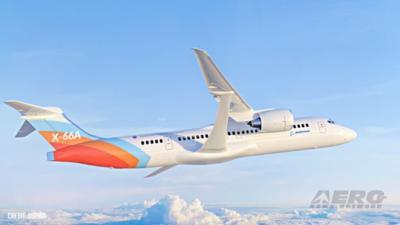
NASA and Boeing recently shared that they are putting the development of their X-66A Sustainable Flight Demonstrator on hold. In the meantime, testing and research of thin wing technology will continue from the ground.

The aircraft project kicked off in 2023 with over a billion dollars of funding from both partners. The plan was to take an old McDonnell Douglas (later Boeing) MD-90 airliner and replace its wings with longer, thinner ones. If the project team’s math checked out, this modification would provide massive cuts to fuel consumption and emissions.

Boeing began the process of breaking down and scanning the MD-90 in early 2024 before starting to remove the jet’s wings and 19 fuselage sections. This would allow the company to install the new Transonic Truss-Braced Wing (TTBW) and, hopefully, get the X-66A in the air in the third quarter of 2028.

At the time, the aerospace giant seemed to have big hopes for the project. It was even hinted that Boeing’s next wide body, replacing the 737, would utilize the same wing design.

Despite this, Boeing and NASA have now confirmed that development of the X-66A Sustainable Flight Demonstrator is being put on hold. The concept is not being thrown out entirely, however.

Boeing has shared that the dynamic duo is “evaluating an updated approach” to the project, continuing to experiment with thin-wing technology while putting work on the full-scale prototype on the back burner.

“We have learned a lot in the past few years partnering with NASA on the X-66 program that will influence the future generations of airplane design,” read a statement from Boeing. “Going forward, we will focus efforts on the single most-promising design feature … the thin-wing design.”

As ground-based research progresses, Boeing will switch multiple engineers from the X-66 project to sectors in need. Specifically, production lines for the 777X and 737 MAX commercial jets.

FMI: www.boeing.com

Advertisement

More News

NTSB Prelim: Cirrus Design Corp SR20

The Airplane Made An Uncommanded Right Yaw And Roll, And He Was Unable To Maintain Control Of The Airplane On November 11, 2025, about 1750 central standard time, a Cirrus SR20, N8>[...]

ANN's Daily Aero-Linx (11.30.25)

Aero Linx: Florida Antique Biplane Association "Biplanes.....outrageous fun since 1903." That quote really defines what the Florida Antique Biplane Association (FABA) is all about.>[...]

ANN's Daily Aero-Term (11.30.25): Wind Shear Escape

Wind Shear Escape An unplanned abortive maneuver initiated by the pilot in command (PIC) as a result of onboard cockpit systems. Wind shear escapes are characterized by maximum thr>[...]

Aero-News: Quote of the Day (11.30.25)

“Working closely with the Polish Armed Forces, we’re focused on disciplined execution to help enhance Poland’s defense capabilities and keep up with the strong de>[...]

Airborne 11.26.25: Bonanza-Baron Fini, Archer v LA NIMBYs, Gogo Loses$$$

Also: Bell 505 on SAF, NYPA Gets Flak For BizAv 'Abuse', FAA Venezuela Caution, Horizon Update Textron Aviation has confirmed it will be ending production of the Beechcraft Bonanza>[...]

blog comments powered by Disqus



Advertisement

Advertisement

Podcasts

Advertisement

© 2007 - 2025 Web Development & Design by Pauli Systems, LC

