
U.S. Navy Selects Rockwell Collins For New E-2D Tactics Trainer | Aero-News Network
Aero-News Network
RSS icon RSS feed
podcast icon MP3 podcast
Subscribe Aero-News e-mail Newsletter Subscribe

Airborne Unlimited -- Most Recent Daily Episodes

Episode Date

Airborne-Monday

Airborne-Tuesday

Airborne-Wednesday Airborne-Thursday

Airborne-Friday

Airborne On YouTube

Airborne-SpecialEpisode-12.15.25

AirborneNextGen-
12.16.25

Airborne-Unlimited-12.10.25

Airborne-AffordableFlyers-12.11.25

AirborneUnlimited-12.12.25

AFE 2025 LIVE MOSAIC Town Hall (Archived): www.airborne-live.net

Sun, Nov 26, 2017

U.S. Navy Selects Rockwell Collins For New E-2D Tactics Trainer

Increases Mission Readiness Through Integrated Training With Other Simulators Throughout The U.S.

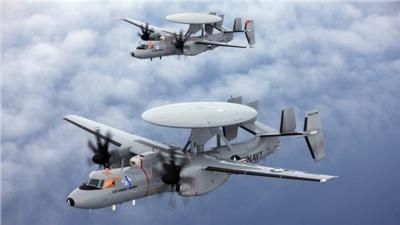
The U.S. Navy has selected Rockwell Collins to provide a new E-2D Advanced Hawkeye Tactics Trainer in support of the E-2D Hawkeye Integrated Training Systems (HITS) III program. The initial contract is valued at $34.5 million with a total of $85.9 million on other E-2D training systems currently in service.

“The Navy will have the tools they need to maintain readiness and train personnel on the complicated mission scenarios involving the E-2D Advanced Hawkeye,” said Nick Gibbs, vice president and general manager of Simulation & Training Solutions (STS) for Rockwell Collins. “Our expertise and experience in developing previous iterations of E-2D training systems helped us meet the Navy’s exact requirements for this program when no one else could.”

This is the fourth tactics trainer to be delivered by Rockwell Collins that will provide the Navy with realistic, adaptable training for the E-2D. The system can be integrated with other trainers throughout the U.S. and can support high-fidelity training in a Live, Virtual, Constructive (LVC) environment. The new tactics trainer will be installed at Naval Base Ventura County in Point Mugu, California and is expected to be completed by August 2020.

Beyond the E-2D Advanced Hawkeye, Rockwell Collins’ proven training systems are adaptable and address the needs of other platforms performing intelligence, surveillance and reconnaissance (ISR), maritime patrol, and airborne early warning and control (AEW&C) special missions.

(Image provided with Rockwell Collins news release)

FMI: www.rockwellcollins.com, www.navy.mil

Advertisement

More News

Aero-News: Quote of the Day (12.18.25)

“These new aircraft strengthen our ability to respond quickly, train effectively and support communities nationwide. Textron Aviation has been a steadfast supporter in helpin>[...]

Classic Aero-TV: Viking Twin Otter 400--Bringing the DHC-6 Back Into Production

From 2011 (YouTube Edition): Rugged, Legendary, STOL Twin Makes A Comeback The de Havilland Twin Otter is an airplane with a long history, and it gained a reputation as a workhorse>[...]

NTSB Final Report: Rans Employee Flying Club Rans S-6ES Coyote II

A Wind Gust Lifted The Right Wing And The Airplane Turned To The Left Analysis: The pilot was departing from a 2,395-ft-long by 50-ft-wide turf runway. The pilot reported that afte>[...]

ANN FAQ: Submit a News Story!

Have A Story That NEEDS To Be Featured On Aero-News? Here’s How To Submit A Story To Our Team Some of the greatest new stories ANN has ever covered have been submitted by our>[...]

ANN's Daily Aero-Term (12.18.25): Braking Action Advisories

Braking Action Advisories When tower controllers receive runway braking action reports which include the terms “medium," “poor," or “nil," or whenever weather con>[...]

blog comments powered by Disqus



Advertisement

Advertisement

Podcasts

Advertisement

© 2007 - 2025 Web Development & Design by Pauli Systems, LC

