Wed, Jan 08, 2003
Increased Quality and Testing Systems Implemented
 Lycoming has received final certification from the FAA for the
production of new crankshafts. Already in limited production on a
risk-release basis (allowing production to begin prior to
certification), these crankshafts will be used to replace
crankshafts in Lycoming engines affected by Service Bulletins 550,
552 and 553.
Lycoming has received final certification from the FAA for the
production of new crankshafts. Already in limited production on a
risk-release basis (allowing production to begin prior to
certification), these crankshafts will be used to replace
crankshafts in Lycoming engines affected by Service Bulletins 550,
552 and 553.
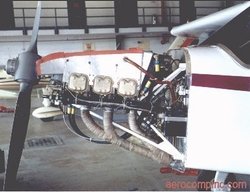
Each crank will be inspected by SEM.
Working closely with the FAA, Lycoming and its supplier have
improved the production, quality and testing processes for the
crankshafts. Additional improvements to these processes
include:
- Press forging of all crankshafts with automated induction
heating
- Temperature monitoring at furnace exit when forging
crankshafts
- Enhanced work instructions for supplier shop floor
personnel
- Comprehensive training of supplier personnel
- Impact (Charpy) testing on all replacement crankshafts
- Scanning Electron Microscope analysis of each crankshaft
- Increased frequency of quality audits at the supplier by
Lycoming personnel
 "We are confident that the new production process
is sound and that stringent systems are in place to protect against
a repeat of the problem. However, as safety is our top priority, we
continue to conduct testing of each and every crankshaft to be
certain the process is working correctly," said Lycoming President
Mike Wolf. To date, more than 600 replacement crankshaft forgings
have been successfully produced and tested.
"We are confident that the new production process
is sound and that stringent systems are in place to protect against
a repeat of the problem. However, as safety is our top priority, we
continue to conduct testing of each and every crankshaft to be
certain the process is working correctly," said Lycoming President
Mike Wolf. To date, more than 600 replacement crankshaft forgings
have been successfully produced and tested.
"Beginning today, about 15 Lycoming Authorized Repair Facilities
around the world, including Lycoming's factory and service center,
will install replacement crankshafts in 20-30 engines a day as
production crankshafts become available," the company said Tuesday.
Lycoming's factory will have an assembly line and staging area
dedicated to both engine inspection and parts flow coordination.
Once off the line, each engine will be thoroughly tested.
Lycoming's goal is to install replacement crankshafts in all the
affected engines by early in the second quarter of 2003.
Unprecedented customer care, in the meantime...
Until the affected engines are returned to service, Lycoming has
offered one of the most extensive Customer Care programs in general
aviation history to help alleviate customer inconvenience. In
addition to repairing and replacing internal parts, the program
includes alternate transportation or fixed costs (includes interest
on loans, ground insurance and hangar rental), and remote hangar
fees, plus an additional 12 month engine warranty from the date the
engine is returned to service. Lycoming has earmarked over $35
million to fund these efforts.
More News
Ultrahigh Frequency (UHF) The frequency band between 300 and 3,000 MHz. The bank of radio frequencies used for military air/ground voice communications. In some instances this may >[...]
During The 7 Second Descent, There Was Another TAWS Alert At Which Time The Engine Remained At Full Power On October 24, 2025 at 2115 mountain daylight time, a Cirrus SR22T, N740TS>[...]
From 2009 (YouTube Edition): Educational Organization Aims to Inspire by Sharing Tuskegee Story Founding leader Don Hinz summarized the Red Tail Project’s mission in simple, >[...]
“This feels like an important step since space travel for people with disabilities is still in its very early days... I’m so thankful and hope it inspires a change in m>[...]
Also: New Katanas, Kern County FD Training, IndiGo’s Botched Roster, MGen. Leavitt Named ERAU Dean The Australian Transportation Safety Bureau (ATSB) has wrapped up its inves>[...]



 ANN's Daily Aero-Term (12.19.25): Ultrahigh Frequency (UHF)


 See All