SECAF Certifies Fischer-Tropsch Blends For B-52H
Secretary of the Air Force Michael W. Wynne announced the
completion of the Air Force's certification of Fischer-Tropsch fuel
blends in the B-52H during an August 8 signing ceremony at Edwards
Air Force Base in California.
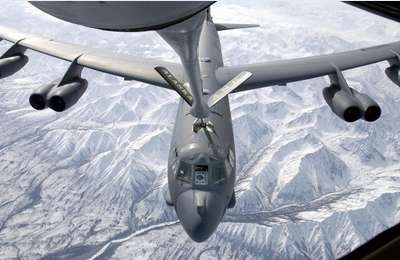
The signing ceremony certified that the blended FT and JP-8 fuel
is safe for operational use in all B-52H aircraft and marked the
formal conclusion of testing.
"The demonstration approach approved by Secretary Wynne in April
2006 identified five execution steps," said Maj. Gen. Curtis Bedke,
Air Force Flight Test Center commander. "The final execution step
began on September 19, 2006. A B-52 was flown at Edwards with two
engines running synthetic fuel and the remaining six engines on
JP-8 fuel. On December 19, 2006, the B-52 was flown with all eight
engines on the FT blend."
The B-52H was chosen as the test platform because of key
advantages such as its eight engines, he said. The fuel system can
simultaneously isolate, carry and manage both a test fuel and the
standard JP-8 fuel. The Air Force plans to test and certify every
airframe to fly on a domestically-produced synthetic fuel blend by
early 2011.
"When I asked that this development be done, the people at
Wright-Patterson Air Force Base, Ohio, and the Air Force Flight
Test Center were excited to push this technology on behalf of the
Air Force and America," said Secretary Wynne.
Every time the price of fuel goes up $10, it costs $600 million
for the Air Force, he said.
"It causes angst to know that we're faced with a commodity that
some might use against us," Secretary Wynne said. "We want to
provide our nation a look forward to something else and to
essentially join with numerous researchers who are looking for
alternatives whether it is ethanol, switch grass, biomass or
Fischer-Tropsch and finding the solution. I think it is going to be
a tremendous partnership across the board."
One of the things planners are looking forward to is a clean
coal to liquid manufacturing process, he said.
"It may involve several manufacturing steps to essentially
neutralize carbon usage and get us to what we want," Secretary
Wynne said. "We want a synthetic blend that will not interrupt the
flow of fuel in our aircraft and airfields and will be a viable
substitute."
A 50 percent blend appears to be the right answer, he said,
adding universities across the country trying to determine why the
Air Force stopped at 50 percent.
"So the question is how do you bring this all to fruition?"
Wynne said. "For many years into the future, it is going to be very
difficult to get more than a 50/50 blend on a real basis and not in
a laboratory."
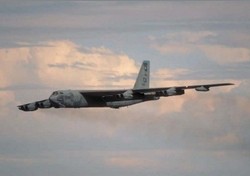 Testers are pleased with the FT
fuel's performance thus far, he said. The fuel may also reduce
maintenance needs.
Testers are pleased with the FT
fuel's performance thus far, he said. The fuel may also reduce
maintenance needs.
The next aircraft to be certified for FT fuel is the C-17.
"This will be a bridge into the commercial arena," Secretary
Wynne said. "We are being watched by many of our airline colleagues
who are not only partnering with us, but researching our data. We
have developed a rigorous process to qualify this fuel and any
manufactured, processed synthetic fuel and blend."
The Air Force manual is being rewritten to highlight that there
is a process to qualify alternative fuels within the Air Force, he
said.
Recently, the Air Force ordered 281,000 gallons of synthetic
fuel for further testing on the C-17 and B-1 engines in the coming
year. NASA is also interested in synthetic fuels and will receive
9,000 gallons of synthetic fuel from the Air Force so they can
begin evaluating its use in various engines and systems.
"This is the tip of the spear for national energy independence
and cleaner energy," Secretary Wynne said. "It is doing well for
the Air Force and the nation."
(Aero-News salutes Senior Airman Jason Hernandez, 95th Air
Base Wing Public Affairs)



 ANN FAQ: Contributing To Aero-TV


 See All