
NTSB Releases Probable Cause Report In 2011 Wright B Flyer Accident | Aero-News Network
Aero-News Network
RSS icon RSS feed
podcast icon MP3 podcast
Subscribe Aero-News e-mail Newsletter Subscribe

Airborne Unlimited -- Most Recent Daily Episodes

Episode Date

Airborne-Monday

Airborne-Tuesday

Airborne-Wednesday Airborne-Thursday

Airborne-Friday

Airborne On YouTube

Airborne-SpecialEpisode-12.15.25

AirborneNextGen-
12.16.25

Airborne-Unlimited-12.10.25

Airborne-AffordableFlyers-12.11.25

AirborneUnlimited-12.12.25

AFE 2025 LIVE MOSAIC Town Hall (Archived): www.airborne-live.net

Tue, Jan 22, 2013

NTSB Releases Probable Cause Report In 2011 Wright B Flyer Accident

Mechanical Failure Traced To An 'Incomplete Weld' On The Left Propeller Shaft

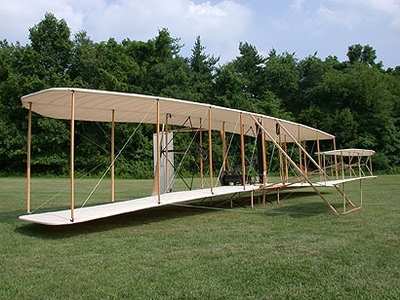
Pilot error following a mechanical failure is the probable cause of an accident involving a replica Wright B Flyer which occurred in Springfield, OH, in July, 2011. The accident resulted in the fatal injury of the two pilots on board the airplane for the test flight.

According to the operator’s accident report:

"The experimental airplane was involved in the initial phases of flight testing. Flying qualities, stability and control and performance were  being tested. Depending on the weather conditions test points were selected from a flight test matrix. The pilots, always two in the aircraft, would brief the flight, fly the test points and document the results.

"Depending on how well the test conditions were met the pilots would show that test point as complete and select another test to fly. The morning of the accident the pilots brief was not attended by any other person; exactly what points they were testing is not known."

NTSB Identification: CEN11FA528
14 CFR Part 91: General Aviation
Accident occurred Saturday, July 30, 2011 in Springfield, OH
Probable Cause Approval Date: 01/15/2013
Aircraft: WRIGHT B FLYER INC WRIGHT B FLYER, registration: N453WB
Injuries: 2 Fatal.

The experimental amateur-built replica airplane was on a test flight with two pilot-rated occupants. Another pilot heard a radio transmission from the accident airplane indicating that they were going to land in a field about 5 miles north of the departure airport. Witnesses reported that the airplane’s engine rpm varied while it was flying at a low altitude. The airplane was then observed in a spiraling descent to the ground. Postaccident examination of the airplane’s left propeller shaft revealed a broken weld, which would have prevented the left propeller from being driven by the engine. Further examination of the joint identified incomplete weld penetration during welding, thus about 25 to 35 percent of the through thickness of the propeller shaft tube was not welded to the propeller shaft end. This incomplete weld penetration occurred in the inner areas of the joint. Visible defects, such as pores and voids, were observed in the welded areas. The part’s engineering drawing specifies complete weld penetration. The on-scene accident examination of the wreckage did not reveal any other preimpact anomalies. Despite the resultant partial loss of thrust, the flight crew should have been able to maintain control of the airplane during the forced landing attempt.

The National Transportation Safety Board determines the probable cause(s) of this accident to be:

The flight crew’s failure to maintain airplane control following a partial loss of engine thrust during cruise flight. Contributing to the accident was the failed weld as a result of incomplete welding on the left propeller shaft, which led to the partial loss of engine thrust.

(Wright B Flyer replica pictured in file photo)

FMI: www.ntsb.gov

Advertisement

More News

ANN's Daily Aero-Term (12.19.25): Ultrahigh Frequency (UHF)

Ultrahigh Frequency (UHF) The frequency band between 300 and 3,000 MHz. The bank of radio frequencies used for military air/ground voice communications. In some instances this may >[...]

NTSB Prelim: Cirrus Design Corp SR22T

During The 7 Second Descent, There Was Another TAWS Alert At Which Time The Engine Remained At Full Power On October 24, 2025 at 2115 mountain daylight time, a Cirrus SR22T, N740TS>[...]

Classic Aero-TV: The Red Tail Project--Carrying the Torch of the Tuskegee Airmen

From 2009 (YouTube Edition): Educational Organization Aims to Inspire by Sharing Tuskegee Story Founding leader Don Hinz summarized the Red Tail Project’s mission in simple, >[...]

Aero-News: Quote of the Day (12.19.25)

“This feels like an important step since space travel for people with disabilities is still in its very early days... I’m so thankful and hope it inspires a change in m>[...]

Airborne 12.17.25: Skydiver Hooks Tail, Cooper Rotax Mount, NTSB v NDAA

Also: New Katanas, Kern County FD Training, IndiGo’s Botched Roster, MGen. Leavitt Named ERAU Dean The Australian Transportation Safety Bureau (ATSB) has wrapped up its inves>[...]

blog comments powered by Disqus



Advertisement

Advertisement

Podcasts

Advertisement

© 2007 - 2025 Web Development & Design by Pauli Systems, LC

