

Aerial Predator Control: Safe Or Silly? | Aero-News Network
Aero-News Network
RSS icon RSS feed
podcast icon MP3 podcast
Subscribe Aero-News e-mail Newsletter Subscribe

Airborne Unlimited -- Most Recent Daily Episodes

Episode Date

Airborne-Monday

Airborne-Tuesday

Airborne-Wednesday Airborne-Thursday

Airborne-Friday

Airborne On YouTube

Airborne-SpecialEpisode-12.15.25

AirborneNextGen-
12.16.25

Airborne-Unlimited-12.10.25

Airborne-AffordableFlyers-12.11.25

AirborneUnlimited-12.12.25

AFE 2025 LIVE MOSAIC Town Hall (Archived): www.airborne-live.net

Mon, Aug 11, 2003

Aerial Predator Control: Safe Or Silly?

NTSB Urges Ban On Aerial Hunts

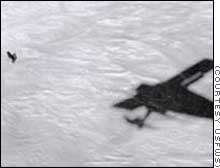
Should ranchers and officials with the Department of Agriculture continue to use aircraft for hunting predators? That question has been answered by at least one authoritative source -- the NTSB.

Steve McCreary, an investigator with the NTSB, said flying close to the ground, as is required when hunting predators, and shooting a gun from a plane do pose some special safety risks.

"You do have to be a bit more precise," he said. "You have to be careful you don't shoot the plane, also." But he said it is unclear whether the safety record of such flights is any better or worse than general aviation.

Conservation groups have a different take on the matter

The group Sinapu, based in Boulder (CO), said it has documented 21 crashes involving federal predator control flights since 1989. The group said there are documented cases of the aircraft hitting trees and power lines and even instances in which the gunner accidentally shot the aircraft.

"Recent crashes that involved shooters who target wildlife from aircraft underscore the necessity of ending this practice," said Wendy Keefover-Ring, with Sinapu's carnivore protection program.

But that might not sit well in other parts of the government, away from the Department of Transportation and the NTSB.

The USDA is the largest operator of such flights through its predator control program. It uses 18 of its own aircraft and also contracts out to private pilots. In June, a USDA-operated predator control flight crashed near Big Timber (MT). The helicopter, operated by the wildlife services division of the USDA, lost all power while maneuvering about 40 feet off the ground, according to an NTSB initial report. The pilot and gunner suffered minor injuries.

But what's the real agenda here? Steve Pilcher, executive vice president of the Montana Stockgrowers Association, said he thinks environmentalists are using the plane crashes as a ruse to end the practice of killing predators. "Like any activity, there is a certain amount of risk attached to it," he said of the flights.

FMI: www.usda.gov, www.ntsb.gov

Advertisement

More News

ANN's Daily Aero-Term (12.19.25): Ultrahigh Frequency (UHF)

Ultrahigh Frequency (UHF) The frequency band between 300 and 3,000 MHz. The bank of radio frequencies used for military air/ground voice communications. In some instances this may >[...]

NTSB Prelim: Cirrus Design Corp SR22T

During The 7 Second Descent, There Was Another TAWS Alert At Which Time The Engine Remained At Full Power On October 24, 2025 at 2115 mountain daylight time, a Cirrus SR22T, N740TS>[...]

Classic Aero-TV: The Red Tail Project--Carrying the Torch of the Tuskegee Airmen

From 2009 (YouTube Edition): Educational Organization Aims to Inspire by Sharing Tuskegee Story Founding leader Don Hinz summarized the Red Tail Project’s mission in simple, >[...]

Aero-News: Quote of the Day (12.19.25)

“This feels like an important step since space travel for people with disabilities is still in its very early days... I’m so thankful and hope it inspires a change in m>[...]

Airborne 12.17.25: Skydiver Hooks Tail, Cooper Rotax Mount, NTSB v NDAA

Also: New Katanas, Kern County FD Training, IndiGo’s Botched Roster, MGen. Leavitt Named ERAU Dean The Australian Transportation Safety Bureau (ATSB) has wrapped up its inves>[...]

blog comments powered by Disqus



Advertisement

Advertisement

Podcasts

Advertisement

© 2007 - 2025 Web Development & Design by Pauli Systems, LC

