
World's First Research Center To Improve Canadians' Air Travel Experience | Aero-News Network
Aero-News Network
RSS icon RSS feed
podcast icon MP3 podcast
Subscribe Aero-News e-mail Newsletter Subscribe

Airborne Unlimited -- Most Recent Daily Episodes

Episode Date

Airborne-Monday

Airborne-Tuesday

Airborne-Wednesday Airborne-Thursday

Airborne-Friday

Airborne On YouTube

Airborne-SpecialEpisode-12.15.25

AirborneNextGen-
12.16.25

Airborne-Unlimited-12.10.25

Airborne-AffordableFlyers-12.11.25

AirborneUnlimited-12.12.25

AFE 2025 LIVE MOSAIC Town Hall (Archived): www.airborne-live.net

Thu, Nov 22, 2018

World's First Research Center To Improve Canadians' Air Travel Experience

Will Study The Experience From Check In To Deplaning

Air transport allows thousands of Canadians to connect with families and explore other parts of the world. It is also at the core of Canada's economic future. Canadian leaders say investment in leading-edge technologies is needed to remain a leader in the aerospace industry and keep air travel safe and enjoyable for all Canadians.

To that end, the Honourable Marc Garneau, Minister of Transport, on behalf of the Honourable Navdeep Bains, Minister of Innovation, Science and Economic Development, has announced the launch of the new Center for Air Travel Research. The new center, managed by the National Research Council of Canada, is the world's first and only facility to study the air travel experience from start to finish; from check-in to terminal, to security, boarding, flying, and deplaning.

All businesses involved in the air travel experience, including airlines, aircraft manufacturers, and cabin equipment and systems suppliers need the right research platforms and technologies to develop and test their solutions to real-world challenges. The Center for Air Travel Research provides the aerospace industry with a flexible, collaborative space to develop, integrate, and evaluate aerospace technologies, systems and materials.

With expertise across a wide range of disciplines, the National Research Council supports the aerospace industry in tackling various air travel challenges. Located next to the Ottawa International Airport, this unique facility will allow companies to evaluate a passenger's complete air travel experience to improve safety, efficiency and comfort for Canadian travellers and visitors.

According to the Canadian government, in 2017, over 140 million passengers travelled through Canadian airports. Last year the aerospace industry made a significant contribution to Canada's economy through more than 188,000 direct and indirect quality jobs and over $24.5 billion (Canadian) in gross domestic product.

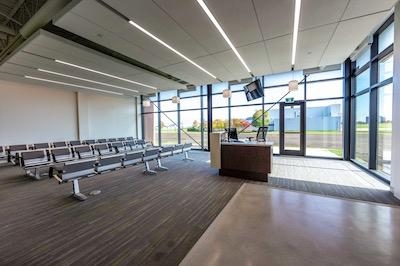
The Center for Air Travel Research has five laboratories that simulate and study a passenger's complete air travel experience. In addition to offering a realistic recreation of an airport terminal, the Center for Air Travel Research also boasts the Flexible Cabin Laboratory, complete with an A320 aircraft cabin that allows for the study of passenger flight experience, human vibration, and more.

"Canadians want safe, efficient, affordable, and comfortable air travel services. The National Research Council of Canada's Center for Air Travel Research - a research and development facility - will benefit travellers, airlines, and aircraft manufacturers from around the world," said The Honourable Marc Garneau, Minister of Transport.

"Using a holistic approach, our simulator draws from our team's diverse knowledge base in areas like environmental controls, vibration, avionics, and human factors to help improve passenger comfort, safety and enroute efficiency. We are proud to be investing in technology platforms that will be critical for the long-term success of the aerospace industry," said Iain Stewart, president of the National Research Council of Canada.

(Image provided with National Research Council Canada news release)

FMI: www.nrc.gc.ca

Advertisement

More News

ANN's Daily Aero-Term (12.19.25): Ultrahigh Frequency (UHF)

Ultrahigh Frequency (UHF) The frequency band between 300 and 3,000 MHz. The bank of radio frequencies used for military air/ground voice communications. In some instances this may >[...]

NTSB Prelim: Cirrus Design Corp SR22T

During The 7 Second Descent, There Was Another TAWS Alert At Which Time The Engine Remained At Full Power On October 24, 2025 at 2115 mountain daylight time, a Cirrus SR22T, N740TS>[...]

Classic Aero-TV: The Red Tail Project--Carrying the Torch of the Tuskegee Airmen

From 2009 (YouTube Edition): Educational Organization Aims to Inspire by Sharing Tuskegee Story Founding leader Don Hinz summarized the Red Tail Project’s mission in simple, >[...]

Aero-News: Quote of the Day (12.19.25)

“This feels like an important step since space travel for people with disabilities is still in its very early days... I’m so thankful and hope it inspires a change in m>[...]

Airborne 12.17.25: Skydiver Hooks Tail, Cooper Rotax Mount, NTSB v NDAA

Also: New Katanas, Kern County FD Training, IndiGo’s Botched Roster, MGen. Leavitt Named ERAU Dean The Australian Transportation Safety Bureau (ATSB) has wrapped up its inves>[...]

blog comments powered by Disqus



Advertisement

Advertisement

Podcasts

Advertisement

© 2007 - 2025 Web Development & Design by Pauli Systems, LC

