Mon, Jun 22, 2015
New Variant On Track To Be Certified For Flight In European Airspace
A significant milestone has been reached in in the Independent Research and Development (IRAD) program to design, develop, and produce a variant of the Predator B RPAfor the General Atomics Predator B unmanned aircraft. The company announced last week that it is on track to be certified for flight according to the NATO Airworthiness Standard for unmanned aircraft.
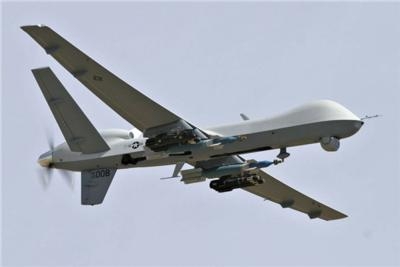
The Certifiable Predator B (CPB) has completed a successful internal Phase 1 Critical Design Review (CDR), along with reviews by two prospective European customers. Development of the system follows international airworthiness standards that include STANAG 4671, UK DEFSTAN 00970, SAE ARP4754A, MIL HDBK-516C, DO-178, and DO-254, as well as others. Certification of delivered systems will be granted by the responsible agencies within each country. The company is on schedule to conduct flight tests of a test aircraft in 2016, leading to the first flight of a certifiable production aircraft in 2017.
“Completion of this first CDR is the culmination of several years of review of requirements and design compliance with the certification agencies,” said Linden Blue, CEO, GA-ASI. “The company also has made a significant investment to solve issues associated with flying RPA within civilian airspace. Certifiable Predator B will represent the first RPA system in its class to achieve this breakthrough.”
Certification-compliant wings and redesigned tails will complete flight-testing on a company-owned Predator B aircraft in late 2015. This flight-testing represents a key milestone for the CPB RPA. The wings span 79 feet and enable over 40 hours of flight time for the aircraft. The company also has applied for FAA Type Certification and is working with the FAA to develop Unmanned Aircraft Systems (UAS) airworthiness standards.
GA-ASI is focused on the development and testing of Detect and Avoid (DAA) capabilities for RPA, combining Traffic and Collision Avoidance System (TCAS) II with the company’s Due Regard Radar (DRR) to enable both automatic collision avoidance and the ability to remain well clear of other airspace users. The integrated DAA system will continue to fly aboard NASA’s Ikhana (Predator B) in 2015 in support of a series of NASA flight tests. These tests will measure the performance of the entire system in a variety of situations to support the ongoing standards development within the RTCA Special Committee 228. Additionally, the CPB aircraft integration testing has confirmed the capability to handle multiple configurations of certified electronics, such as Technical Standard Orders (TSO)-certified Identification Friend or Foe (IFF) transponders and communications radios from other industry partners.
(Image from file)
More News
Ultrahigh Frequency (UHF) The frequency band between 300 and 3,000 MHz. The bank of radio frequencies used for military air/ground voice communications. In some instances this may >[...]
During The 7 Second Descent, There Was Another TAWS Alert At Which Time The Engine Remained At Full Power On October 24, 2025 at 2115 mountain daylight time, a Cirrus SR22T, N740TS>[...]
From 2009 (YouTube Edition): Educational Organization Aims to Inspire by Sharing Tuskegee Story Founding leader Don Hinz summarized the Red Tail Project’s mission in simple, >[...]
“This feels like an important step since space travel for people with disabilities is still in its very early days... I’m so thankful and hope it inspires a change in m>[...]
Also: New Katanas, Kern County FD Training, IndiGo’s Botched Roster, MGen. Leavitt Named ERAU Dean The Australian Transportation Safety Bureau (ATSB) has wrapped up its inves>[...]



 ANN's Daily Aero-Term (12.19.25): Ultrahigh Frequency (UHF)


 See All