
NASA, French Aerospace Lab To Collaborate On Sonic Boom Prediction Research | Aero-News Network
Aero-News Network
RSS icon RSS feed
podcast icon MP3 podcast
Subscribe Aero-News e-mail Newsletter Subscribe

Airborne Unlimited -- Most Recent Daily Episodes

Episode Date

Airborne-Monday

Airborne-Tuesday

Airborne-Wednesday Airborne-Thursday

Airborne-Friday

Airborne On YouTube

Airborne-Unlimited-12.01.25

AirborneNextGen-
12.02.25

Airborne-Unlimited-11.19.25

Airborne-AffordableFlyers-11.20.25

AirborneUnlimited-11.21.25

LIVE MOSAIC Town Hall (Archived): www.airborne-live.net

Wed, Aug 01, 2018

NASA, French Aerospace Lab To Collaborate On Sonic Boom Prediction Research

Could Lead To Practical Supersonic Travel Over Land

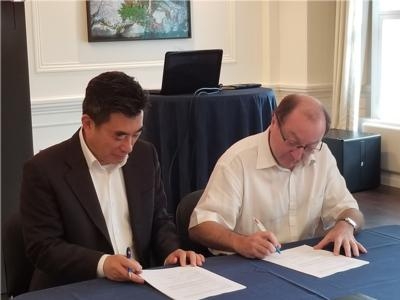
NASA and France’s Office National d'Etudes et de Recherches Aerospatiales (ONERA), the French national aerospace research center, have signed a research agreement that could make supersonic passenger flights over land practical, dramatically reducing travel time in the United States or anywhere in the world.

NASA and ONERA agreed to collaborate on research predicting where sonic booms will be heard as supersonic aircraft fly overhead. This could lead to alleviating the effects of the loud noise caused by sonic booms.

The agreement, signed during bilateral meetings held in conjunction with the 2018 Farnborough International Air Show in the United Kingdom, is the 12th agreement between the two organizations and the third that is still active. The most recent agreement, signed in September 2016, involved collaboration on aircraft noise research.

“This partnership shows there is interest in supersonic travel all over the world,” said Jaiwon Shin, NASA’s associate administrator for aeronautics. “Solving the issue of annoying sonic booms could ultimately cut travel time to worldwide destinations in half.”

“This new partnership comes as a natural follow-up to a decade of successful cooperation between NASA and ONERA on the topic of aircraft noise mitigation, as well as an exciting perspective to revive the pioneering era of supersonic aviation,” said Bruno Sainjon, ONERA’s chief executive officer.

The cooperation under this agreement will create a forum through which NASA and ONERA can share technical knowledge and data in order to independently improve their own capabilities, with the overall objective of mitigating the effects of sonic booms produced by civil air transportation.

Both organizations will define common verification cases, use numerical tools to predict where sonic booms will reach the ground, and perform detailed analyses and comparisons of the results. NASA’s efforts toward this agreement complement work currently taking place at NASA’s Langley Research Center in Virginia.

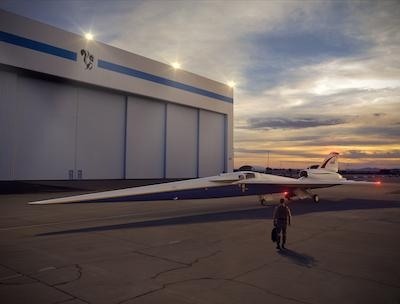
NASA is committed to conducting research that will enable a robust commercial supersonic market, including faster-than-sound air travel over land. The agency’s X-59 quiet supersonic technology airplane is the cornerstone of this effort.

(Images provided with NASA news release and from file)

FMI: www.nasa.gov

Advertisement

More News

ANN's Daily Aero-Term (11.29.25): Waypoint

Waypoint A predetermined geographical position used for route/instrument approach definition, progress reports, published VFR routes, visual reporting points or points for transiti>[...]

ANN's Daily Aero-Linx (11.29.25)

Aero Linx: Sentimental Journey to Cub Haven Sentimental Journey Flyin began in 1986 with a group of dedicated volunteers working to provide a sentimental return to Lock Haven, the >[...]

NTSB Prelim: Jabiru USA Sport Aircraft LLC J230-SP

The Pilot Would Often Fly Over Their House At A Low Altitude And That Family Members Would Go Outside To Wave On November 14, 2025, at 1708 eastern standard time, a Jabiru USA Spor>[...]

Classic Aero-TV: Crafting The Future of eVTOL Infrastructure

From 2024 (YouTube Edition): Volatus Infrastructure Paves The Way The name “Volatus” seems to be everywhere these days, popping up in a series of partnerships and proje>[...]

Klyde Morris (11.28.25)

Fortnite Conquers All, Klyde FMI: www.klydemorris.com>[...]

blog comments powered by Disqus



Advertisement

Advertisement

Podcasts

Advertisement

© 2007 - 2025 Web Development & Design by Pauli Systems, LC

