
NASA Awards $100,000 To Winning Robot Challenge Team | Aero-News Network
Aero-News Network
RSS icon RSS feed
podcast icon MP3 podcast
Subscribe Aero-News e-mail Newsletter Subscribe

Airborne Unlimited -- Most Recent Daily Episodes

Episode Date

Airborne-Monday

Airborne-Tuesday

Airborne-Wednesday Airborne-Thursday

Airborne-Friday

Airborne On YouTube

Airborne-SpecialEpisode-12.15.25

AirborneNextGen-
12.16.25

Airborne-Unlimited-12.10.25

Airborne-AffordableFlyers-12.11.25

AirborneUnlimited-12.12.25

AFE 2025 LIVE MOSAIC Town Hall (Archived): www.airborne-live.net

Mon, Jun 22, 2015

NASA Awards $100,000 To Winning Robot Challenge Team

West Virginia University Morgantown Team Claims The Top Prize

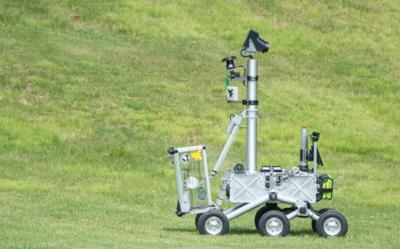
NASA has awarded $100,000 in prize money to the Mountaineers, a team from West Virginia University, Morgantown, for successfully completing Level 2 of the Sample Return Robot Challenge, part of the agency's Centennial Challenges prize program.

Worcester Polytechnic Institute (WPI) hosted the event June 10-12 at its Worcester, Massachusetts, campus. This was the fourth year NASA and WPI held the Sample Robot Return competition.

Dennis Andrucyk, deputy associate administrator for the Space Technology Mission Directorate at NASA Headquarters in Washington, and NASA astronaut Cady Coleman presented awards to the Mountaineers team members Saturday at the opening of TouchTomorrow, a science and robotics technology festival. The festival, which was open to the public, highlighted the teams and robots, as well as NASA and WPI exhibits in science, robotics and space technology.

"It was wonderful to see the teams compete and demonstrate their expertise with autonomous robotic systems," said Andrucyk. "NASA uses competitions like these to help maintain and advance America's leadership in technology and innovation. As we've seen this week, pushing the state-of-the-art in robotics will ultimately increase the effectiveness and safety of humans in space and will enable cutting-edge scientific exploration of the solar system."

The objective of the challenge is to encourage innovations in autonomous navigation and robotics technologies. Teams were required to demonstrate their robots could locate and collect geologic samples from wide and varied terrains, operating without human control.

The challenge includes two levels of competition. For a robot to complete Level 1 successfully, it must depart a starting platform in search of a sample, the specifications of which were previously programmed into the robot's onboard computer. Operating autonomously, the robot has 30 minutes to locate, capture and return to its starting platform with one undamaged sample. Teams that complete Level 1 may move on to Level 2.

For Level 2, robots have two hours to return autonomously at least two undamaged samples, including a sample known previously to the team and one introduced the day of the competition. Samples collected in Level 2 are categorized as easy, intermediate and hard based on the complexity of their shape, size and design. More points are awarded for those classified as hard. In this year’s competition, samples ranged in shape and size from rectangular to round.

(Image provided by NASA)

FMI: www.nasa.gov

Advertisement

More News

ANN's Daily Aero-Term (12.19.25): Ultrahigh Frequency (UHF)

Ultrahigh Frequency (UHF) The frequency band between 300 and 3,000 MHz. The bank of radio frequencies used for military air/ground voice communications. In some instances this may >[...]

NTSB Prelim: Cirrus Design Corp SR22T

During The 7 Second Descent, There Was Another TAWS Alert At Which Time The Engine Remained At Full Power On October 24, 2025 at 2115 mountain daylight time, a Cirrus SR22T, N740TS>[...]

Classic Aero-TV: The Red Tail Project--Carrying the Torch of the Tuskegee Airmen

From 2009 (YouTube Edition): Educational Organization Aims to Inspire by Sharing Tuskegee Story Founding leader Don Hinz summarized the Red Tail Project’s mission in simple, >[...]

Aero-News: Quote of the Day (12.19.25)

“This feels like an important step since space travel for people with disabilities is still in its very early days... I’m so thankful and hope it inspires a change in m>[...]

Airborne 12.17.25: Skydiver Hooks Tail, Cooper Rotax Mount, NTSB v NDAA

Also: New Katanas, Kern County FD Training, IndiGo’s Botched Roster, MGen. Leavitt Named ERAU Dean The Australian Transportation Safety Bureau (ATSB) has wrapped up its inves>[...]

blog comments powered by Disqus



Advertisement

Advertisement

Podcasts

Advertisement

© 2007 - 2025 Web Development & Design by Pauli Systems, LC

