
Marines Give Thumbs-Up To Ospreys In Iraq | Aero-News Network
Aero-News Network
RSS icon RSS feed
podcast icon MP3 podcast
Subscribe Aero-News e-mail Newsletter Subscribe

Airborne Unlimited -- Most Recent Daily Episodes

Episode Date

Airborne-Monday

Airborne-Tuesday

Airborne-Wednesday Airborne-Thursday

Airborne-Friday

Airborne On YouTube

Airborne-SpecialEpisode-12.15.25

AirborneNextGen-
12.16.25

Airborne-Unlimited-12.10.25

Airborne-AffordableFlyers-12.11.25

AirborneUnlimited-12.12.25

AFE 2025 LIVE MOSAIC Town Hall (Archived): www.airborne-live.net

Wed, Oct 22, 2008

Marines Give Thumbs-Up To Ospreys In Iraq

But Admit Tilt-Rotor Aircraft Hasn't Been Battle-Tested

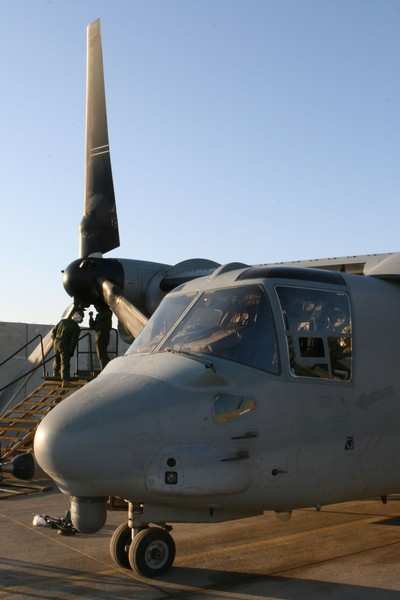
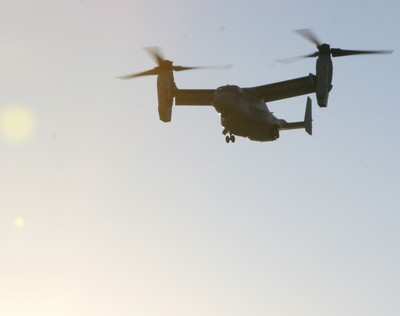
It's hard to recall an aircraft which was criticized more during its development than the V-22 Osprey. But after a year of deployment in Iraq without a major incident, the pilots who fly the tilt-rotor hybrid are giving it great reviews.

The Associated Press reports the Osprey has won over the Marine pilots who first flew it into a war zone... despite critics who said it lacked adequate armor and firepower, descends too slowly, is less maneuverable than a helicopter, cannot autorotate if engines fail, and kicks up too much dust.

But pilots say they appreciate the Osprey's speed advantage over the helicopters it is displacing, like the CH-46 Sea Knight. One says he can take the plane to altitudes beyond the reach of small-arms fire, "like a bat out of hell."

Military officials admit that direct comparisons to older helicopters can't yet be made, in part because modern-day political considerations limit the military's willingness to expose servicemen to risks.

Major Paul Kopacz led two Ospreys on a recent mission to Fallujah, and comments, "It's not the same World War II tactics that we used to deal with, or even Vietnam tactics. We have not been battle-tested because we aren't going guns blazing into hot zones. Our nation is now too sensitive to the loss of soldiers to let that happen."

To be fair, skeptics still remember problems that beset the V-22 during its development, including a series of technical failures and deadly crashes. Two of those accidents came in quick succession in 2000, killing a total of 23 Marines, and nearly ending the Osprey's development.

Military officials admit a few technical glitches in the field, many involving avionics or contamination of sensitive parts by the ubiquitous dust in the Iraq theater.

But they also consider the aircraft safe enough to have used it to transport Democrat presidential candidate Barack Obama around Iraq on his tour earlier this year.

FMI: www.marines.mil

Advertisement

More News

ANN's Daily Aero-Term (12.19.25): Ultrahigh Frequency (UHF)

Ultrahigh Frequency (UHF) The frequency band between 300 and 3,000 MHz. The bank of radio frequencies used for military air/ground voice communications. In some instances this may >[...]

NTSB Prelim: Cirrus Design Corp SR22T

During The 7 Second Descent, There Was Another TAWS Alert At Which Time The Engine Remained At Full Power On October 24, 2025 at 2115 mountain daylight time, a Cirrus SR22T, N740TS>[...]

Classic Aero-TV: The Red Tail Project--Carrying the Torch of the Tuskegee Airmen

From 2009 (YouTube Edition): Educational Organization Aims to Inspire by Sharing Tuskegee Story Founding leader Don Hinz summarized the Red Tail Project’s mission in simple, >[...]

Aero-News: Quote of the Day (12.19.25)

“This feels like an important step since space travel for people with disabilities is still in its very early days... I’m so thankful and hope it inspires a change in m>[...]

Airborne 12.17.25: Skydiver Hooks Tail, Cooper Rotax Mount, NTSB v NDAA

Also: New Katanas, Kern County FD Training, IndiGo’s Botched Roster, MGen. Leavitt Named ERAU Dean The Australian Transportation Safety Bureau (ATSB) has wrapped up its inves>[...]

blog comments powered by Disqus



Advertisement

Advertisement

Podcasts

Advertisement

© 2007 - 2025 Web Development & Design by Pauli Systems, LC

