
US Navy Taps BAE To Provide Critical Mine Detection Sensor Prototype | Aero-News Network
Aero-News Network
RSS icon RSS feed
podcast icon MP3 podcast
Subscribe Aero-News e-mail Newsletter Subscribe

Airborne Unlimited -- Most Recent Daily Episodes

Episode Date

Airborne-Monday

Airborne-Tuesday

Airborne-Wednesday Airborne-Thursday

Airborne-Friday

Airborne On YouTube

Airborne-SpecialEpisode-12.15.25

AirborneNextGen-
12.16.25

Airborne-Unlimited-12.10.25

Airborne-AffordableFlyers-12.11.25

AirborneUnlimited-12.12.25

AFE 2025 LIVE MOSAIC Town Hall (Archived): www.airborne-live.net

Sun, Apr 14, 2013

US Navy Taps BAE To Provide Critical Mine Detection Sensor Prototype

Protecting Sailors And U.S. Marines From Prolific Threats Is A 24-7 Need

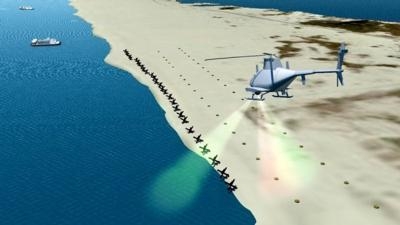
BAE Systems has been awarded a $20 million contract to develop an advanced prototype system that detects mines and obstacles in near-shore waters for the U.S. Navy and Marine Corps. As part of the Coastal Battlefield Reconnaissance and Analysis (COBRA) program, the laser-based airborne system will provide 24-hour capability to ensure our troops’ safe transition from ship to shore.

“This program will help save lives, and to us there is no better reward than providing technology to help protect those who put themselves in harm’s way while serving our nation,” said Reid Noguchi, general manager of BAE Systems Spectral Solutions. “Having conducted extensive research and development in advanced sensors, airborne prototype systems, and sophisticated real time software, BAE Systems has worked closely with the Office of Naval Research (ONR) to mature the technologies and capabilities to meet the Navy’s mine countermeasures needs on an accelerated timeline.”

These technologies are being prototyped under Section 819 of the National Defense Authorization Act, which is aimed at the development of advanced components or prototypes, according to Brian Almquist, program officer in the ONR Ocean Battlespace Sensing Department. “This law helps to reduce acquisition costs and also accelerates delivery of technology to the fleet to protect our sailors and marines from this prolific threat,” Almquist said.

(Artist's rendering of BAE COBRA system)

FMI: www.baesystems.com

Advertisement

More News

Aero-News: Quote of the Day (12.18.25)

“These new aircraft strengthen our ability to respond quickly, train effectively and support communities nationwide. Textron Aviation has been a steadfast supporter in helpin>[...]

Classic Aero-TV: Viking Twin Otter 400--Bringing the DHC-6 Back Into Production

From 2011 (YouTube Edition): Rugged, Legendary, STOL Twin Makes A Comeback The de Havilland Twin Otter is an airplane with a long history, and it gained a reputation as a workhorse>[...]

NTSB Final Report: Rans Employee Flying Club Rans S-6ES Coyote II

A Wind Gust Lifted The Right Wing And The Airplane Turned To The Left Analysis: The pilot was departing from a 2,395-ft-long by 50-ft-wide turf runway. The pilot reported that afte>[...]

ANN FAQ: Submit a News Story!

Have A Story That NEEDS To Be Featured On Aero-News? Here’s How To Submit A Story To Our Team Some of the greatest new stories ANN has ever covered have been submitted by our>[...]

ANN's Daily Aero-Term (12.18.25): Braking Action Advisories

Braking Action Advisories When tower controllers receive runway braking action reports which include the terms “medium," “poor," or “nil," or whenever weather con>[...]

blog comments powered by Disqus



Advertisement

Advertisement

Podcasts

Advertisement

© 2007 - 2025 Web Development & Design by Pauli Systems, LC

