
Supersonic Laminar Flow Tests Continue On NASA's F-15B | Aero-News Network
Aero-News Network
RSS icon RSS feed
podcast icon MP3 podcast
Subscribe Aero-News e-mail Newsletter Subscribe

Airborne Unlimited -- Most Recent Daily Episodes

Episode Date

Airborne-Monday

Airborne-Tuesday

Airborne-Wednesday Airborne-Thursday

Airborne-Friday

Airborne On YouTube

Airborne-SpecialEpisode-12.15.25

AirborneNextGen-
12.16.25

Airborne-Unlimited-12.10.25

Airborne-AffordableFlyers-12.11.25

AirborneUnlimited-12.12.25

AFE 2025 LIVE MOSAIC Town Hall (Archived): www.airborne-live.net

Mon, Jul 22, 2013

Supersonic Laminar Flow Tests Continue On NASA's F-15B

Small Test Airfoil Being Evaluated In Conjunction With Aerion Corporation

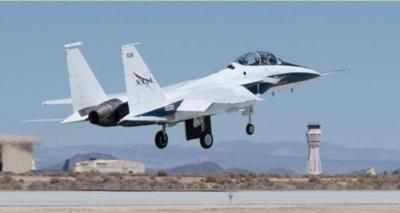
NASA Dryden Flight Research Center’s F-15B Research Testbed aircraft has been busy this year, flying an experimental test fixture in partnership with Aerion Corporation of Reno, Nevada.

Called the Supersonic Boundary Layer Transition, Phase II, or SBLT-II, the experiment consists of flying a small test airfoil, or wing section, attached underneath the F-15B. This allows NASA and Aerion engineers to continue investigating the extent and robustness of natural laminar flow over the test section at supersonic speeds.

Conducting the experiment in actual supersonic flight conditions with the F-15B enables engineers to capture data in a real-world flight environment, allowing for more precise refining of supersonic natural laminar flow airfoil design. “The objective of the flight series is to investigate the extent and robustness of smooth, or laminar, airflow over the specially-designed test airfoil,” said Brett Pauer, NASA Dryden’s deputy High Speed Project manager. “Then, researchers will work to better understand when imperfections in the airfoil’s surface cause the air to transition from laminar to rough, turbulent flow. The greater the extent of laminar airflow over a wing, the less aerodynamic drag there is, which reduces fuel consumption,” Pauer said.

It is believed that significant laminar flow has never been achieved on any production supersonic aircraft before, so this research and the data being collected from the SBLT-II test fixture may help provide some of the data that might enable the design of supersonic aircraft in the future that have wings that produce laminar flow at supersonic cruise conditions.

One of the goals of NASA’s High Speed Project, which utilizes the F-15B and other high performance jets, is reducing the fuel consumption and increasing efficiency of future supersonic aircraft.

(Image provided by NASA.)

FMI: www.nasa.gov

Advertisement

More News

ANN's Daily Aero-Term (12.19.25): Ultrahigh Frequency (UHF)

Ultrahigh Frequency (UHF) The frequency band between 300 and 3,000 MHz. The bank of radio frequencies used for military air/ground voice communications. In some instances this may >[...]

NTSB Prelim: Cirrus Design Corp SR22T

During The 7 Second Descent, There Was Another TAWS Alert At Which Time The Engine Remained At Full Power On October 24, 2025 at 2115 mountain daylight time, a Cirrus SR22T, N740TS>[...]

Classic Aero-TV: The Red Tail Project--Carrying the Torch of the Tuskegee Airmen

From 2009 (YouTube Edition): Educational Organization Aims to Inspire by Sharing Tuskegee Story Founding leader Don Hinz summarized the Red Tail Project’s mission in simple, >[...]

Aero-News: Quote of the Day (12.19.25)

“This feels like an important step since space travel for people with disabilities is still in its very early days... I’m so thankful and hope it inspires a change in m>[...]

Airborne 12.17.25: Skydiver Hooks Tail, Cooper Rotax Mount, NTSB v NDAA

Also: New Katanas, Kern County FD Training, IndiGo’s Botched Roster, MGen. Leavitt Named ERAU Dean The Australian Transportation Safety Bureau (ATSB) has wrapped up its inves>[...]

blog comments powered by Disqus



Advertisement

Advertisement

Podcasts

Advertisement

© 2007 - 2025 Web Development & Design by Pauli Systems, LC

