
NASA Selects Science Instrument Upgrade For Flying Observatory | Aero-News Network
Aero-News Network
RSS icon RSS feed
podcast icon MP3 podcast
Subscribe Aero-News e-mail Newsletter Subscribe

Airborne Unlimited -- Most Recent Daily Episodes

Episode Date

Airborne-Monday

Airborne-Tuesday

Airborne-Wednesday Airborne-Thursday

Airborne-Friday

Airborne On YouTube

Airborne-SpecialEpisode-12.15.25

AirborneNextGen-
12.16.25

Airborne-Unlimited-12.10.25

Airborne-AffordableFlyers-12.11.25

AirborneUnlimited-12.12.25

AFE 2025 LIVE MOSAIC Town Hall (Archived): www.airborne-live.net

Sun, Apr 22, 2012

NASA Selects Science Instrument Upgrade For Flying Observatory

Hi-Res Airborne Wideband Camera To Fly On SOFIA Aircraft

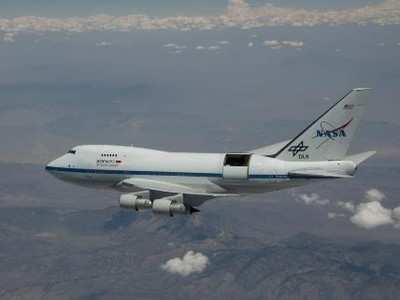
NASA has selected a science instrument upgrade to the Stratospheric Observatory for Infrared Astronomy (SOFIA) airborne observatory. The instrument, the High-resolution Airborne Wideband Camera (HAWC), will provide a sensitive, versatile and reliable imaging capability to the SOFIA user community. The upgrade involves two proposals that will allow the observatory to measure the structure and strength of magnetic fields in diverse objects throughout the universe, such as star-forming clouds and galaxies. This will help astronomers better understand how stars, planets and galaxies form and evolve.

SOFIA is a highly modified Boeing 747SP aircraft that carries a telescope with a 100-inch (2.5-meter) diameter reflecting mirror that conducts astronomy research not possible with ground-based telescopes. By operating in the stratosphere at altitudes up to 45,000 feet, SOFIA can make observations above the water vapor in Earth's lower atmosphere. "SOFIA has the ability to become a world-class airborne observatory that complements the Hubble, Spitzer and Herschel space telescopes," said John Grunsfeld, NASA's Science Mission Directorate associate administrator. "This upgrade will greatly broaden SOFIA's capabilities."

Last August, the agency released an Announcement of Opportunity for SOFIA second-generation instrument investigations and received 11 proposals. The selected proposals were judged to have the best science value and feasible development plans.

The selected proposals are:

  • The High-resolution Airborne Wideband Camera Polarization (HAWC-Pol), Charles Dowell, principal investigator, NASA's Jet Propulsion Laboratory, Pasadena, CA. This investigation upgrades the HAWC instrument to include the capability to make polarimetric observations at far-infrared wavelengths. The investigation's main goals are to measure the magnetic field in the interstellar medium, star forming regions and the center of the Milky Way.
  • HAWC++, Johannes Staguhn, Johns Hopkins University, Baltimore, MD. This investigation will provide a sensitive, large-format detector array to the HAWC-Pol investigation, increasing its observing efficiency and providing a broader range of targets.

(Image provided by NASA)

FMI: www.nasa.gov/sofia

Advertisement

More News

ANN's Daily Aero-Term (12.19.25): Ultrahigh Frequency (UHF)

Ultrahigh Frequency (UHF) The frequency band between 300 and 3,000 MHz. The bank of radio frequencies used for military air/ground voice communications. In some instances this may >[...]

NTSB Prelim: Cirrus Design Corp SR22T

During The 7 Second Descent, There Was Another TAWS Alert At Which Time The Engine Remained At Full Power On October 24, 2025 at 2115 mountain daylight time, a Cirrus SR22T, N740TS>[...]

Classic Aero-TV: The Red Tail Project--Carrying the Torch of the Tuskegee Airmen

From 2009 (YouTube Edition): Educational Organization Aims to Inspire by Sharing Tuskegee Story Founding leader Don Hinz summarized the Red Tail Project’s mission in simple, >[...]

Aero-News: Quote of the Day (12.19.25)

“This feels like an important step since space travel for people with disabilities is still in its very early days... I’m so thankful and hope it inspires a change in m>[...]

Airborne 12.17.25: Skydiver Hooks Tail, Cooper Rotax Mount, NTSB v NDAA

Also: New Katanas, Kern County FD Training, IndiGo’s Botched Roster, MGen. Leavitt Named ERAU Dean The Australian Transportation Safety Bureau (ATSB) has wrapped up its inves>[...]

blog comments powered by Disqus



Advertisement

Advertisement

Podcasts

Advertisement

© 2007 - 2025 Web Development & Design by Pauli Systems, LC

