
Atlas V Rocket Assembled for Starliner Launch to ISS | Aero-News Network
Aero-News Network
RSS icon RSS feed
podcast icon MP3 podcast
Subscribe Aero-News e-mail Newsletter Subscribe

Airborne Unlimited -- Most Recent Daily Episodes

Episode Date

Airborne-Monday

Airborne-Tuesday

Airborne-Wednesday Airborne-Thursday

Airborne-Friday

Airborne On YouTube

Airborne-Unlimited-12.01.25

AirborneNextGen-
12.02.25

Airborne-Unlimited-11.19.25

Airborne-AffordableFlyers-11.20.25

AirborneUnlimited-11.21.25

LIVE MOSAIC Town Hall (Archived): www.airborne-live.net

Mon, Jul 12, 2021

Atlas V Rocket Assembled for Starliner Launch to ISS

Technicians Will Soon Power The Atlas V To Test Flight Controls

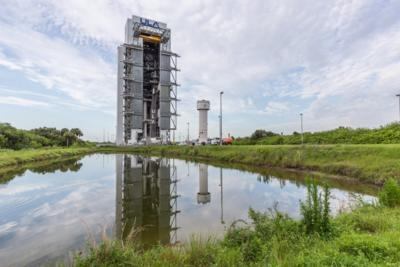
United Launch Alliance’s (ULA) Atlas V rocket has been assembled in preparation for Boeing’s much-delayed Orbital Flight Test-2 (OFT-2) launch to the International Space Station as part of NASA’s Commercial Crew Program.

Engineers in ULA’s Vertical Integration Facility (VIF) used large cranes to assemble the stages of the rocket in an upright position on its mobile launch platform, which will carry the Atlas V and Starliner from the VIF to the pad for launch.

To verify the rocket is ready to launch, technicians will soon power the Atlas V to test flight controls, check the engine steering profiles, and conduct a combined systems test.

The 172-foot-tall rocket will be fully completed when the Starliner is mounted aboard the Atlas V. A ULA payload transporter will move the capsule from Boeing’s Commercial Crew and Cargo Processing Facility (C3PF) at the Kennedy Space Center to the nearby VIF for attachment.

The Atlas V will propel Starliner off the pad on 1.6 million pounds of thrust on its second uncrewed flight test from Space Launch Complex-41 at Cape Canaveral Space Force Station in Florida no earlier than July 30.

As Boeing’s second uncrewed flight for NASA’s Commercial Crew Program, OFT-2 will serve as an end-to-end flight test to prove the Atlas V rocket and Starliner are ready for regular missions launching astronauts to and from the space station.

FMI: www.nasa.gov

Advertisement

More News

ANN's Daily Aero-Term (12.01.25): Convective SIGMET

Convective SIGMET A weather advisory concerning convective weather significant to the safety of all aircraft. Convective SIGMETs are issued for tornadoes, lines of thunderstorms, e>[...]

ANN's Daily Aero-Linx (12.01.25)

Aero Linx: United Flying Octogenarians WELCOME to a most extraordinary group of aviators, the United Flying Octogenarians (UFO). Founded in 1982 with just a handful of pilots, we h>[...]

NTSB Final Report: Remos Aircraft GmbH Remos GX

Pilot’s Decision To Attempt Takeoff With Frost Covering The Airplane’s Wings Analysis: The pilot of the light sport airplane was preparing to depart for a cross-country>[...]

Aero-News: Quote of the Day (12.02.25)

“We’ve paid for the cable line’s repair for the customer and have apologized for the inconvenience this caused them...” Source: Some followup info from an A>[...]

ANN's Daily Aero-Term (12.02.25): Coupled Approach

Coupled Approach An instrument approach performed by the aircraft autopilot, and/or visually depicted on the flight director, which is receiving position information and/or steerin>[...]

blog comments powered by Disqus



Advertisement

Advertisement

Podcasts

Advertisement

© 2007 - 2025 Web Development & Design by Pauli Systems, LC

