First Major Modernization For The Aircraft In Two Decades
The newly updated Kiowa Warrior aircraft, the OH-58F, made a ceremonial "first flight," April 30, at Redstone Arsenal, AL. With new cockpit and sensor modifications installed, the OH-58F represents the first major upgrade or modernization to the Kiowa Warrior in 20 years. The "cockpit and sensor upgrade program," called CASUP, converts OH-58D Kiowa Warriors into OH-58F models. The CASUP program is "designed to address obsolescence in the aircraft as well as the capabilities of the sensor," said Col. Robert Grigsby, project manager, Armed Scout Helicopters.
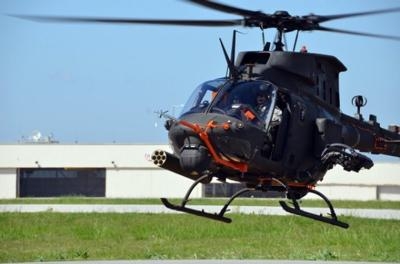
The Army says that the biggest change to the aircraft is that the familiar sensor ball, which is mast-mounted above the rotor in older models, has been moved down to the front of the aircraft. The nose-mounted common sensor payload includes improved optics, an infra-red sensor, laser pointer and laser spot tracker. Col. John Lynch, Training and Doctrine Command capability manager for the Kiowa Warrior, said mounting the sensor package on the nose of the aircraft was a decision made after considering operations over the last 12 years in Iraq and Afghanistan.
"We are really doing a lot more maneuvering flight both in urban and non-urban environments, and the sight quickly reaches the stop limits and it is very difficult to track targets when you are flying in an environment where you are getting much closer to the enemy than we ever envisioned with the mast-mounted sensor in the Cold War-era," Lynch said.
Lynch did say the aircraft will be "a little more exposed" by using the nose-mounted sight instead of the mast-mounted sight. But other factors in the battle space mitigate that exposure. "[With] the linkages that are provided through communications, through manned-unmanned teaming in the current generation of aircraft as opposed to the original OH-58D in the late 1980s, and teaming with other aircraft such as the AH-64 Apache, we believe we will be able to overcome that risk and still perform the mission in major combat operation-type environment," Lynch said. "Based on what we've seen in the last ten years, we can certainly expect to be deployed in more environments like the current operating environment in Afghanistan, or recently, in Iraq."
The OH-58F also includes a new digital cockpit that can be customized by the crew to display information relevant to the mission. Additionally, the OH-58F brings doubled processing speed to the aircraft, as well as improved recording and storage capability. Both the pilot and co-pilot will now have their own, separate map and data viewing capability. The OH-58F is also about 160 pounds lighter than the D model of the aircraft, which means that commanders have more mission flexibility when using the aircraft.
"Understanding where the Kiowa Warrior operates today, which is trading both fuel and ammunition for every mission, I think this provides additional flexibility to the commander and crew," he said. A weight reduction on the aircraft means it can carry more fuel for increased flight time, or more rockets or ammunition. "I think flexibility is really the key thing it's going to provide."
The OH-58A model appeared in the Army in the late 1960s, during the Vietnam era. Some of the aircraft in the Army inventory today are more than 40 years old. But the CASUP doesn't "zero-time" the aircraft. "About 60 percent of the airframe will be replaced," said Lt. Col. Matt Hannah, product manager, Kiowa Warrior. "But there's 40 percent that is literally still 42 years old today, and when you finish the production line, 55 years old."
Grigsby said a decision is pending now in the Army to either go after a replacement for the Kiowa Warrior -- that's the Armed Aerial Scout program -- or completely overhaul the Kiowa Warrior with a service life extension program, called SLEP.
Right now, the Prototype Integration Facility at Redstone Arsenal, Ala., is building the "Prototype Qualification 1" OH-58F aircraft. In the fall, production will transition to Corpus Christi Army Depot, Corpus Christi, Texas, to build PQ2, PQ3, and PQ4, as the Army prepares for milestone C decision. In the fall of 2014, it's expected the Army will conduct a limited user test of the aircraft, and by March 2015, the Army will make a low-rate initial production decision. The LRIP Lot 1 set includes 27 aircraft and LRIP Lot 2 includes 33 aircraft. The decision to go into full-rate production will yield a total of 368 OH-58F Kiowa Warriors, to be built between 2017-2025.
"The program is doing well, and we are on track," Hannah said.
The OH-58D Kiowa Warrior has the highest operational tempo of any Army aircraft in theater. On average, it maintains a monthly operational tempo of about 75 hours. Last year in theater, that number was more than 100 hours a month. The CASUP program, which converts the D model into F models, brings much capability to the well-used aircraft.
(OH-58F image provided by the U.S. Army)



 NTSB Prelim: Cirrus Design Corp SR20


 See All