
First Plane To Antarctica Found By Researchers | Aero-News Network
Aero-News Network
RSS icon RSS feed
podcast icon MP3 podcast
Subscribe Aero-News e-mail Newsletter Subscribe

Airborne Unlimited -- Most Recent Daily Episodes

Episode Date

Airborne-Monday

Airborne-Tuesday

Airborne-Wednesday Airborne-Thursday

Airborne-Friday

Airborne On YouTube

Airborne-SpecialEpisode-12.15.25

AirborneNextGen-
12.16.25

Airborne-Unlimited-12.10.25

Airborne-AffordableFlyers-12.11.25

AirborneUnlimited-12.12.25

AFE 2025 LIVE MOSAIC Town Hall (Archived): www.airborne-live.net

Sun, Jan 03, 2010

First Plane To Antarctica Found By Researchers

Aircraft Recovery Attributed To Luck

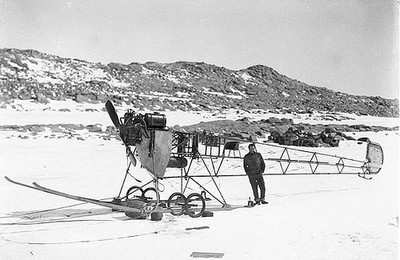
The fuselage of the first aircraft taken to Antarctica, a Vickers REP Monoplane, was found on Friday by a team from the Mawson's Huts Foundation.  The Australian group, dedicated to preserving the history of Antarctic explorer Sir Douglas Mawson, has been searching for the relic for the past three years.

"Luck has been on our side and it's been a great episode in the history of Antarctic aviation," said Dr Tony Stewart, the current expedition's leader, after the lucky New Year's Day discovery.

Antarctic explorer Sir Douglas Mawson initially intended to use the Vickers Monoplane to the first flight over the polar ice cap during his 1911-1914 expedition.  A crash during a pre-expedition exhibition flight damaged the wings and left no time for repairs. 

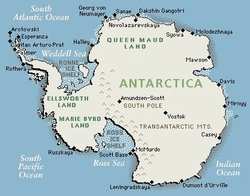
Mawson still took the plane and relegated it to a new ground-based role as an 'air tractor' to pull sleds on skis.  The engine performed poorly, seizing up in the cold, and was eventually shipped back to Vickers in England.  The fuselage was abandoned in Commonwealth Bay in 1913.

Dr. Stewart and his team brought high-tech equipment to aid in the search for the plane, but their eyes were the most useful tool.

"Magnetometer, ground-penetrating radar metal detectors and all sorts of things to try and look for it, but in the end it was just a combination of a very low tide, good weather and a thin ice melt," he said.

"Our carpenter was just taking a walk along the beach and just saw the metal in 10 centimeters of water, just right next to the ice." explained Stewart.

"This is the first time those rocks have been exposed in that area for some time so we've been walking around that area above the air tractor not knowing it was there under our feet all this time."

FMI: http://www.mawsons-huts.org.au/

Advertisement

More News

ANN's Daily Aero-Term (12.19.25): Ultrahigh Frequency (UHF)

Ultrahigh Frequency (UHF) The frequency band between 300 and 3,000 MHz. The bank of radio frequencies used for military air/ground voice communications. In some instances this may >[...]

NTSB Prelim: Cirrus Design Corp SR22T

During The 7 Second Descent, There Was Another TAWS Alert At Which Time The Engine Remained At Full Power On October 24, 2025 at 2115 mountain daylight time, a Cirrus SR22T, N740TS>[...]

Classic Aero-TV: The Red Tail Project--Carrying the Torch of the Tuskegee Airmen

From 2009 (YouTube Edition): Educational Organization Aims to Inspire by Sharing Tuskegee Story Founding leader Don Hinz summarized the Red Tail Project’s mission in simple, >[...]

Aero-News: Quote of the Day (12.19.25)

“This feels like an important step since space travel for people with disabilities is still in its very early days... I’m so thankful and hope it inspires a change in m>[...]

Airborne 12.17.25: Skydiver Hooks Tail, Cooper Rotax Mount, NTSB v NDAA

Also: New Katanas, Kern County FD Training, IndiGo’s Botched Roster, MGen. Leavitt Named ERAU Dean The Australian Transportation Safety Bureau (ATSB) has wrapped up its inves>[...]

blog comments powered by Disqus



Advertisement

Advertisement

Podcasts

Advertisement

© 2007 - 2025 Web Development & Design by Pauli Systems, LC

