
Erik Lindbergh Dedicates NASA's SOFIA In Honor Of Grandfather | Aero-News Network
Aero-News Network
RSS icon RSS feed
podcast icon MP3 podcast
Subscribe Aero-News e-mail Newsletter Subscribe

Airborne Unlimited -- Most Recent Daily Episodes

Episode Date

Airborne-Monday

Airborne-Tuesday

Airborne-Wednesday Airborne-Thursday

Airborne-Friday

Airborne On YouTube

Airborne-SpecialEpisode-12.15.25

AirborneNextGen-
12.16.25

Airborne-Unlimited-12.10.25

Airborne-AffordableFlyers-12.11.25

AirborneUnlimited-12.12.25

AFE 2025 LIVE MOSAIC Town Hall (Archived): www.airborne-live.net

Tue, May 22, 2007

Erik Lindbergh Dedicates NASA's SOFIA In Honor Of Grandfather

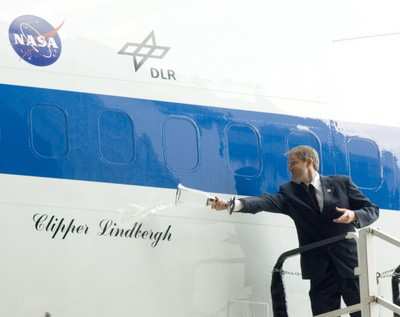
Modified Pan Am 747 Carries Its Original Name -- "Clipper Lindbergh"

NASA dedicated a unique astronomy aircraft Monday to pioneering aviator Charles Lindbergh on the 80th anniversary of his historic transatlantic flight. Erik Lindbergh, the pilot's grandson, joined NASA for the event May 21, in Waco, TX.

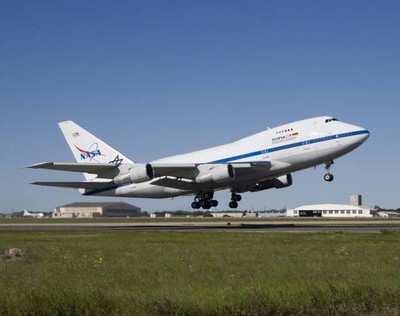
NASA's new Stratospheric Observatory for Infrared Astronomy (SOFIA) is a highly modified 747 airliner that carries a 45,000-pound infrared telescope system. Pan American Airways originally christened the plane the "Clipper Lindbergh" in 1977. At the rededication ceremony, NASA officials discussed the similarities between Lindbergh's accomplishments and SOFIA's potential to capture scientifically important infrared images unavailable to earthbound telescopes.

The SOFIA aircraft was modified at L-3 Systems in Waco and is wrapping up a series of functional checkout flights before heading to NASA's Dryden Flight Research Center, Edwards Air Force Base, CA for further tests and systems integration.

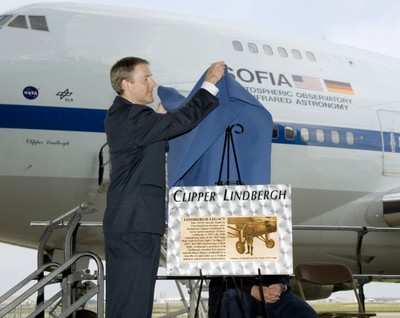
Erik Lindbergh unveiled a plaque commemorating Clipper Lindbergh. "This project is a fantastic blend of a 20th century legacy aircraft and a 21st century platform for exploration," he said.

Intended to fly above 40,000 feet, SOFIA will place its infrared telescope above nearly 99 percent of the Earth's atmospheric water vapor, greatly enhancing its abilities to study the cosmos. Its state-of-the-art telescope will be able to carry out scientific missions with greater flexibility and ease of upgrade than a satellite-borne observatory.

NASA's partner in SOFIA is the German Aerospace Center, which provided the telescope. NASA modified the aircraft. A 16-foot-high opening has been cut into the aft fuselage to permit observations to be made at altitude. Once it arrives at Dryden, SOFIA will continue flight and systems testing for about two years while its observatory system hardware and software are integrated with the aircraft. The telescope's first images are expected in 2009.

FMI: www.sofia.usra.edu

Advertisement

More News

ANN's Daily Aero-Term (12.19.25): Ultrahigh Frequency (UHF)

Ultrahigh Frequency (UHF) The frequency band between 300 and 3,000 MHz. The bank of radio frequencies used for military air/ground voice communications. In some instances this may >[...]

NTSB Prelim: Cirrus Design Corp SR22T

During The 7 Second Descent, There Was Another TAWS Alert At Which Time The Engine Remained At Full Power On October 24, 2025 at 2115 mountain daylight time, a Cirrus SR22T, N740TS>[...]

Classic Aero-TV: The Red Tail Project--Carrying the Torch of the Tuskegee Airmen

From 2009 (YouTube Edition): Educational Organization Aims to Inspire by Sharing Tuskegee Story Founding leader Don Hinz summarized the Red Tail Project’s mission in simple, >[...]

Aero-News: Quote of the Day (12.19.25)

“This feels like an important step since space travel for people with disabilities is still in its very early days... I’m so thankful and hope it inspires a change in m>[...]

Airborne 12.17.25: Skydiver Hooks Tail, Cooper Rotax Mount, NTSB v NDAA

Also: New Katanas, Kern County FD Training, IndiGo’s Botched Roster, MGen. Leavitt Named ERAU Dean The Australian Transportation Safety Bureau (ATSB) has wrapped up its inves>[...]

blog comments powered by Disqus



Advertisement

Advertisement

Podcasts

Advertisement

© 2007 - 2025 Web Development & Design by Pauli Systems, LC

