Scheduled To Touch Down May 25
NASA's Phoenix Mars Lander is preparing to end its long journey
and begin a three-month mission to taste and sniff fistfuls of
Martian soil and buried ice. The lander is scheduled to touch down
on the Red Planet May 25.
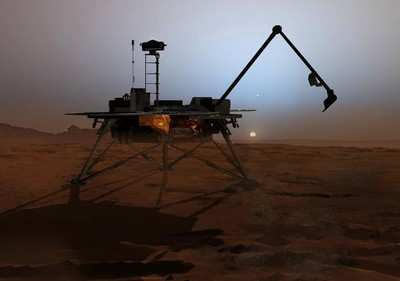
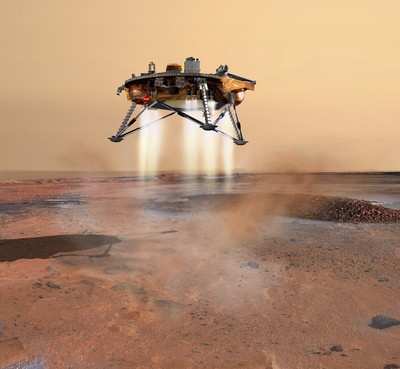
Phoenix will enter the top of the Martian atmosphere at almost
13,000 mph. In seven minutes, the spacecraft must complete a
challenging sequence of events to slow to about five miles-per-hour
before its three legs reach the ground. Confirmation of the landing
could come as early as 1953 EDT.
"This is not a trip to grandma's house. Putting a spacecraft
safely on Mars is hard and risky," said Ed Weiler, associate
administrator for NASA's Science Mission Directorate at NASA
Headquarters in Washington. "Internationally, fewer than half the
attempts have succeeded."
 Rocks large enough to spoil the
landing or prevent opening of the solar panels present the biggest
known risk. However, images from the High Resolution Imaging
Science Experiment (HiRISE) camera on NASA's Mars Reconnaissance
Orbiter, detailed enough to show individual rocks smaller than the
lander, have helped lessen that risk.
Rocks large enough to spoil the
landing or prevent opening of the solar panels present the biggest
known risk. However, images from the High Resolution Imaging
Science Experiment (HiRISE) camera on NASA's Mars Reconnaissance
Orbiter, detailed enough to show individual rocks smaller than the
lander, have helped lessen that risk.
"We have blanketed nearly the entire landing area with HiRISE
images," said Ray Arvidson of Washington University in St. Louis,
chairman of the Phoenix landing-site working group.
"This is one of the least rocky areas on all of Mars and we are
confident that rocks will not detrimentally impact the ability of
Phoenix to land safely."
As ANN has reported, Phoenix
uses hardware from a spacecraft built for a 2001 launch that was
canceled in response to the loss of a similar Mars spacecraft
during a 1999 landing attempt. Researchers who proposed the Phoenix
mission in 2002 saw the unused spacecraft as a resource for
pursuing a new science opportunity.
Earlier in 2002, NASA's Mars Odyssey orbiter discovered that
plentiful water ice lies just beneath the surface throughout much
of high-latitude Mars. NASA chose the Phoenix proposal over 24
other proposals to become the first endeavor in the Mars Scout
program of competitively selected missions. "Phoenix will land
farther north on Mars than any previous mission," said Phoenix
Project Manager Barry Goldstein of NASA's Jet Propulsion
Laboratory, Pasadena, CA.
"The Phoenix mission not only studies the northern permafrost
region, but takes the next step in Mars exploration by determining
whether this region, which may encompass as much as 25 percent of
the Martian surface, is habitable," said Peter Smith, Phoenix
principal investigator at the University of Arizona, Tucson.
The solar-powered robotic lander will manipulate a 7.7-foot arm
to scoop up samples of underground ice and soil lying above the
ice. Onboard laboratory instruments will analyze the samples.
Cameras and a Canadian-supplied weather station will supply other
information about the site's environment.
One research goal is to assess whether conditions at the site
ever have been favorable for microbial life. The composition and
texture of soil above the ice could give clues to whether the ice
ever melts in response to long-term climate cycles. Another
important question is whether the scooped-up samples contain
carbon-based chemicals that are potential building blocks and food
for life.



 ANN's Daily Aero-Linx (12.12.25)


 See All