
NASA Says Phoenix Still On Track For May 25 Landing | Aero-News Network
Aero-News Network
RSS icon RSS feed
podcast icon MP3 podcast
Subscribe Aero-News e-mail Newsletter Subscribe

Airborne Unlimited -- Most Recent Daily Episodes

Episode Date

Airborne-Monday

Airborne-Tuesday

Airborne-Wednesday Airborne-Thursday

Airborne-Friday

Airborne On YouTube

Airborne-SpecialEpisode-12.15.25

AirborneNextGen-
12.16.25

Airborne-Unlimited-12.10.25

Airborne-AffordableFlyers-12.11.25

AirborneUnlimited-12.12.25

AFE 2025 LIVE MOSAIC Town Hall (Archived): www.airborne-live.net

Fri, May 23, 2008

NASA Says Phoenix Still On Track For May 25 Landing

Scheduled To Land On Mars Sunday Afternoon

With three days and 3 million miles left to fly before arriving at Mars, NASA says its Phoenix spacecraft is on track for its destination in the Martian arctic.

"The latest calculation from our navigation team shows the center of the area where we're currently headed lies less than eight miles from the center of our target area," said Barry Goldstein, Phoenix project manager at NASA's Jet Propulsion Laboratory, Pasadena, CA. "We may decide on Saturday that we don't need to use our final opportunity for fine tuning the trajectory Phoenix is on. Either way, we will continue to monitor the trajectory throughout Saturday night, on the off chance we need to execute our contingency maneuver eight hours before entry."

The spacecraft remains in good health. "All systems are nominal and stable," said Ed Sedivy, Phoenix spacecraft program manager for Lockheed Martin Space Systems, Denver, which built the spacecraft. "We have plenty of propellant, the temperatures look good and the batteries are fully charged."

The spacecraft is closing in on the scariest seven minutes of the mission.

On Sunday, shortly after the annual 500-mile race at the Indianapolis Motor Speedway, Phoenix will be approaching Mars at about 12,750 miles per hour, a speed that could cover 500 miles in 2 minutes and 22 seconds.

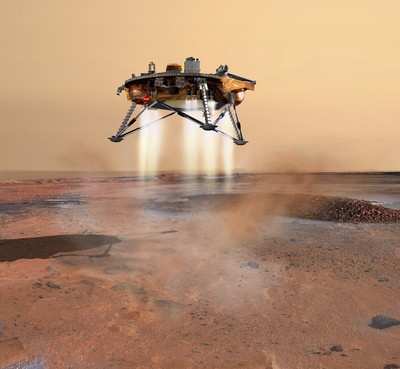
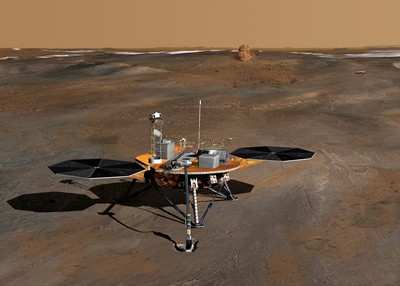
After it enters the top of the Martian atmosphere at that velocity, it must use superheated friction with the atmosphere, a strong parachute and a set of pulsing retrorockets to achieve a safe, three-legged standstill touchdown on the surface in just seven minutes.

The earliest possible time when mission controllers could get confirmation from Phoenix indicating it has survived landing will be at 1653 Pacific Time on Sunday (1953 Eastern Time). Those will be anxious moments for controllers on Earth; of 11 previous attempts that various nations have made to land spacecraft on Mars, only five have succeeded.

NASA is understandably eager to get to .500.

FMI: www.nasa.gov/phoenix, http://phoenix.lpl.arizona.edu

Advertisement

More News

Aero-TV: DeltaHawk’s Diesel Power Steps Into the Spotlight

Its Offerings Are Lighter, Cleaner, and Now Pushing Past 1,000nm on SAF Jet Fuel DeltaHawk’s diesel-powered aircraft lineup has seen incredible upgrades over the last few yea>[...]

NTSB Prelim: Mooney Aircraft Corp. M20K

The Airplane Experienced A Total Loss Of Engine Power On December 3, 2025, about 1600 central standard time, a Mooney Aircraft Corp. M20K, N57229, was substantially damaged when it>[...]

ANN FAQ: Turn On Post Notifications

Make Sure You NEVER Miss A New Story From Aero-News Network Do you ever feel like you never see posts from a certain person or page on Facebook or Instagram? Here’s how you c>[...]

ANN's Daily Aero-Linx (12.20.25)

Aero Linx: European Society of Aerospace Medicine (ESAM) As a pan-European, independent forum, it works to promote the safety and health of all persons involved in aviation and spa>[...]

Aero-News: Quote of the Day (12.20.25)

“We are excited to see Wisk achieve this milestone, and I’m so proud of the team that made it possible. The team at Wisk has built advanced technologies across flight c>[...]

blog comments powered by Disqus



Advertisement

Advertisement

Podcasts

Advertisement

© 2007 - 2025 Web Development & Design by Pauli Systems, LC

