
NASA Thruster Achieves World-Record 5.5 Years Of Operation | Aero-News Network
Aero-News Network
RSS icon RSS feed
podcast icon MP3 podcast
Subscribe Aero-News e-mail Newsletter Subscribe

Airborne Unlimited -- Most Recent Daily Episodes

Episode Date

Airborne-Monday

Airborne-Tuesday

Airborne-Wednesday Airborne-Thursday

Airborne-Friday

Airborne On YouTube

Airborne-Unlimited-11.24.25

AirborneNextGen-
11.18.25

Airborne-Unlimited-11.19.25

Airborne-AffordableFlyers-11.20.25

AirborneUnlimited-11.21.25

LIVE MOSAIC Town Hall (Archived): www.airborne-live.net

Mon, Jul 01, 2013

NASA Thruster Achieves World-Record 5.5 Years Of Operation

Advanced Ion Engine Has Run Continuously for 48,000 Hours

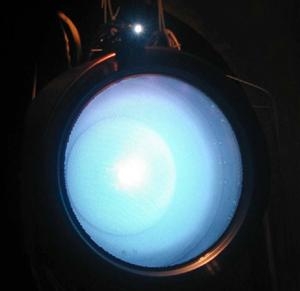
A NASA advanced ion propulsion engine has successfully operated for more than 48,000 hours, or 5 and a half years, making it the longest test duration of any type of space propulsion system demonstration project ever. The thruster was developed under NASA's Evolutionary Xenon Thruster (NEXT) Project at NASA's Glenn Research Center in Cleveland. Glenn manufactured the test engine's core ionization chamber. Aerojet Rocketdyne of Sacramento, CA, designed and built the ion acceleration assembly.

The 7-kilowatt class thruster could be used in a wide range of science missions, including deep space missions identified in NASA's Planetary Science Decadal Survey. "The NEXT thruster operated for more than 48,000 hours," said Michael J. Patterson, principal investigator for NEXT at Glenn. "We will voluntarily terminate this test at the end of this month, with the thruster fully operational. Life and performance have exceeded the requirements for any anticipated science mission."

The NEXT engine is a type of solar electric propulsion in which thruster systems use the electricity generated by the spacecraft's solar panel to accelerate the xenon propellant to speeds of up to 90,000 mph. This provides a dramatic improvement in performance compared to conventional chemical rocket engines. During the endurance test performed in a high vacuum test chamber at Glenn, the engine consumed about 1,918 pounds of xenon propellant, providing an amount of total impulse that would take more than 22,000 pounds of conventional rocket propellant for comparable applications.

"Aerojet Rocketdyne fully supports NASA's vision to develop high power solar electric propulsion for future exploration," said Julie Van Kleeck, Aerojet Rocketdyne's vice president for space advanced programs. "NASA-developed next generation high power solar electric propulsion systems will enhance our nation's ability to perform future science and human exploration missions."

(NEXT ion thruster image provided by NASA.)

FMI: www.Rocket.com

Advertisement

More News

ANN's Daily Aero-Term (11.28.25): Unmanned Aircraft System (UAS)

Unmanned Aircraft System (UAS) An unmanned aircraft and its associated elements related to safe operations, which may include control stations (ground, ship, or air based), control>[...]

ANN's Daily Aero-Linx (11.28.25)

Aero Linx: Cactus Fly-In The Classic Airplane Association of Arizona, Inc. (CAAA) was incorporated in Arizona as a not for profit corporation on January 10, 2014. The CAAA roster i>[...]

Airborne 11.21.25: NTSB on UPS Accident, Shutdown Protections, Enstrom Update

Also: UFC Buys Tecnams, Emirates B777-9 Buy, Allegiant Pickets, F-22 And MQ-20 The NTSB's preliminary report on the UPS Flight 2976 crash has focused on the left engine pylon's sep>[...]

Airborne 11.26.25: Bonanza-Baron Fini, Archer v LA NIMBYs, Gogo Loses$$$

Also: Bell 505 on SAF, NYPA Gets Flak For BizAv 'Abuse', FAA Venezuela Caution, Horizon Update Textron Aviation has confirmed it will be ending production of the Beechcraft Bonanza>[...]

Airborne-NextGen 11.25.25: EHang Manned Flt, Army UAVs, Starship V3 Booster Boom

Also: FedEx SAF, Archer Midnight Powertrain Tech, Rocket Lab Record, Perseverance Rover Find EHang has logged a major milestone in the development of its pilotless air taxi, loggin>[...]

blog comments powered by Disqus



Advertisement

Advertisement

Podcasts

Advertisement

© 2007 - 2025 Web Development & Design by Pauli Systems, LC

