
NASA To Demonstrate Sonic 'Thump' Compared To Standard Sonic Boom | Aero-News Network
Aero-News Network
RSS icon RSS feed
podcast icon MP3 podcast
Subscribe Aero-News e-mail Newsletter Subscribe

Airborne Unlimited -- Most Recent Daily Episodes

Episode Date

Airborne-Monday

Airborne-Tuesday

Airborne-Wednesday Airborne-Thursday

Airborne-Friday

Airborne On YouTube

Airborne-SpecialEpisode-12.15.25

AirborneNextGen-
12.16.25

Airborne-Unlimited-12.10.25

Airborne-AffordableFlyers-12.11.25

AirborneUnlimited-12.12.25

AFE 2025 LIVE MOSAIC Town Hall (Archived): www.airborne-live.net

Mon, May 23, 2016

NASA To Demonstrate Sonic 'Thump' Compared To Standard Sonic Boom

Event To Take Place May 31 At Armstrong Flight Research Center

NASA is planning a comparative demonstration of the currently louder sonic boom to a quieter, more community-friendly sonic "thump", which NASA looks to achieve through an experimental aircraft for Quiet Supersonic Technology (QueSST).

The May 31 event beginning at 9:00 a.m. PDT will be held at NASA's Armstrong Flight Research Center in Edwards, California, where manned supersonic flight was first achieved in 1947.

The event will feature supersonic flyovers by a NASA F/A-18 'Hornet' aircraft. The jet will produce a conventional, largely audible sonic boom, followed by another pass, in which it will perform a special dive maneuver, demonstrating a quieter "thump" in place of the boom. The quieter thump is closely similar to what NASA engineers believe supersonic flight may sound like through QueSST.

The disruptive sonic boom is the primary cause for the FAA's restriction on supersonic flight over land. NASA's efforts in QueSST may open the future to supersonic aviation on a commercial level.

In addition to the supersonic demonstration, NASA will feature presentations from Commercial Supersonic Technology program managers.

Following the supersonic portion of the event, NASA Armstrong will then showcase current efforts to safely integrate Unmanned Aircraft Systems into the National Airspace System (UAS-NAS).

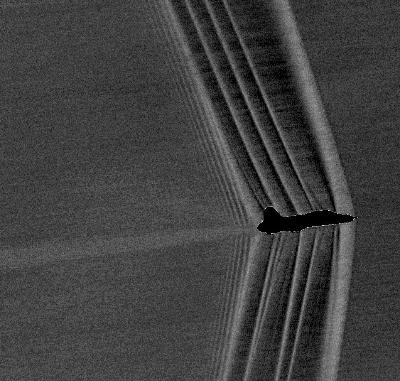
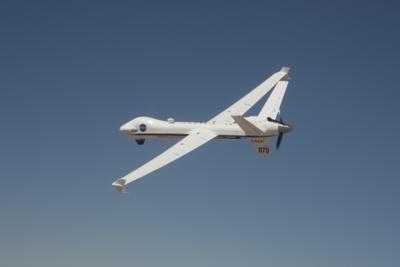
(Images provided with NASA news release. Top: Shockwaves produced by a U.S. Air Force Test Pilot School T-38 aircraft in supersonic flight are captured by NASA researchers using a special filter and camera on the ground. Bottom: NASA's Ikhana is being used for the development of regulations to integrate Unmanned Aircraft Systems in the National Airspace System)

FMI: www.nasa.gov/centers/armstrong

Advertisement

More News

ANN's Daily Aero-Term (12.19.25): Ultrahigh Frequency (UHF)

Ultrahigh Frequency (UHF) The frequency band between 300 and 3,000 MHz. The bank of radio frequencies used for military air/ground voice communications. In some instances this may >[...]

NTSB Prelim: Cirrus Design Corp SR22T

During The 7 Second Descent, There Was Another TAWS Alert At Which Time The Engine Remained At Full Power On October 24, 2025 at 2115 mountain daylight time, a Cirrus SR22T, N740TS>[...]

Classic Aero-TV: The Red Tail Project--Carrying the Torch of the Tuskegee Airmen

From 2009 (YouTube Edition): Educational Organization Aims to Inspire by Sharing Tuskegee Story Founding leader Don Hinz summarized the Red Tail Project’s mission in simple, >[...]

Aero-News: Quote of the Day (12.19.25)

“This feels like an important step since space travel for people with disabilities is still in its very early days... I’m so thankful and hope it inspires a change in m>[...]

Airborne 12.17.25: Skydiver Hooks Tail, Cooper Rotax Mount, NTSB v NDAA

Also: New Katanas, Kern County FD Training, IndiGo’s Botched Roster, MGen. Leavitt Named ERAU Dean The Australian Transportation Safety Bureau (ATSB) has wrapped up its inves>[...]

blog comments powered by Disqus



Advertisement

Advertisement

Podcasts

Advertisement

© 2007 - 2025 Web Development & Design by Pauli Systems, LC

