Wed, Jul 30, 2003
Northrop Grumman F-5E Modified For Sonic Boom Demonstration
Completes First Flight
 An F-5E fighter jet
with a modified fuselage has completed its initial flight in
preparation for a joint government-industry test program to
demonstrate the relationship between the shape of a supersonic
aircraft and the strength of the sonic boom it creates. The Shaped
Sonic Boom Demonstration (SSBD) program is jointly sponsored by the
Defense Advanced Research Projects Agency (DARPA), Northrop Grumman
Corporation's Integrated Systems sector and NASA Langley Research
Center. This program is scheduled to begin in several weeks at
NASA's Dryden Flight Research Center, Edwards Air Force Base
(CA).
An F-5E fighter jet
with a modified fuselage has completed its initial flight in
preparation for a joint government-industry test program to
demonstrate the relationship between the shape of a supersonic
aircraft and the strength of the sonic boom it creates. The Shaped
Sonic Boom Demonstration (SSBD) program is jointly sponsored by the
Defense Advanced Research Projects Agency (DARPA), Northrop Grumman
Corporation's Integrated Systems sector and NASA Langley Research
Center. This program is scheduled to begin in several weeks at
NASA's Dryden Flight Research Center, Edwards Air Force Base
(CA).
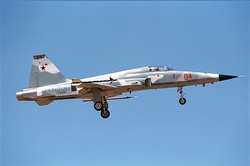 The demonstrations are part
of DARPA's Quiet Supersonic Platform (QSP) program, an ongoing
effort to identify and mature technologies that could allow
military and business aircraft to operate with reduced sonic boom.
"Our objective is to show that by modifying the shape of an
aircraft, the shape and behavior of shock waves -- and therefore
the intensity of a sonic boom -- can be significantly
altered," said Charles Boccadoro, Northrop Grumman's QSP program
manager. "This technology could eventually enable
unrestricted supersonic flight over land." In the July 24 flight,
an F-5E provided by the US Naval Air Systems Command took to
the air for the first time since it was modified for the
SSBD. The modifications, performed at Northrop Grumman's St.
Augustine, Fla., facility, include a specially shaped "nose glove"
and the addition of aluminum substructure and composite "skin" to
the underside of the fuselage. Test pilot Roy Martin reported
that performance matched the preflight simulation.
The demonstrations are part
of DARPA's Quiet Supersonic Platform (QSP) program, an ongoing
effort to identify and mature technologies that could allow
military and business aircraft to operate with reduced sonic boom.
"Our objective is to show that by modifying the shape of an
aircraft, the shape and behavior of shock waves -- and therefore
the intensity of a sonic boom -- can be significantly
altered," said Charles Boccadoro, Northrop Grumman's QSP program
manager. "This technology could eventually enable
unrestricted supersonic flight over land." In the July 24 flight,
an F-5E provided by the US Naval Air Systems Command took to
the air for the first time since it was modified for the
SSBD. The modifications, performed at Northrop Grumman's St.
Augustine, Fla., facility, include a specially shaped "nose glove"
and the addition of aluminum substructure and composite "skin" to
the underside of the fuselage. Test pilot Roy Martin reported
that performance matched the preflight simulation.
Northrop Grumman will move the aircraft to its facility in
Palmdale (CA) for additional checkout flights before the SSBD
data-collection flights begin.
An aircraft traveling through the atmosphere continuously
produces air-pressure waves similar to the waves created by the bow
of a ship as it moves through water. When the aircraft
exceeds the speed of sound (about 750 miles per hour at sea level),
the pressure waves combine to form shock waves. The noise
heard on the ground as a sonic boom is the sudden onset and release
of pressure after the buildup by the shock wave, also known as
"peak overpressure." During the upcoming SSBD flight
demonstrations, the modified F-5E will be flown through the
supersonic corridor at the NASA Dryden Flight Research
Center. Sensors on the ground and in other aircraft will
measure the sonic boom overpressure. Shortly thereafter, an
unmodified F-5E will be flown through the same air space, and its
sonic boom will be measured.
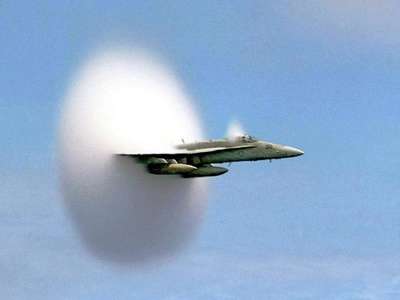
By comparing the signatures of the two aircraft, test engineers
expect to be able to learn more about the effects of aircraft
shaping on the sonic boom. Northrop Grumman has been under contract
with DARPA's QSP program since 2000. As part of its work, the
company has designed a long-range supersonic aircraft with military
strike and business jet variants and validated key integration
technologies associated with that design. "Our work on the QSP
program builds upon our advanced development capabilities to
identify solutions for future aircraft systems," said
Boccadoro. "Demonstration of a shaped sonic boom could help
usher in a new era of supersonic aircraft."
More News
Ultrahigh Frequency (UHF) The frequency band between 300 and 3,000 MHz. The bank of radio frequencies used for military air/ground voice communications. In some instances this may >[...]
During The 7 Second Descent, There Was Another TAWS Alert At Which Time The Engine Remained At Full Power On October 24, 2025 at 2115 mountain daylight time, a Cirrus SR22T, N740TS>[...]
From 2009 (YouTube Edition): Educational Organization Aims to Inspire by Sharing Tuskegee Story Founding leader Don Hinz summarized the Red Tail Project’s mission in simple, >[...]
“This feels like an important step since space travel for people with disabilities is still in its very early days... I’m so thankful and hope it inspires a change in m>[...]
Also: New Katanas, Kern County FD Training, IndiGo’s Botched Roster, MGen. Leavitt Named ERAU Dean The Australian Transportation Safety Bureau (ATSB) has wrapped up its inves>[...]



 ANN's Daily Aero-Term (12.19.25): Ultrahigh Frequency (UHF)


 See All