Crew Vehicle And Denver Facilities Unveiled By Lockheed
Martin
The first Orion spacecraft and a spacious state-of-the-art Space
Operations Simulation Center (SOSC) were unveiled by Lockheed
Martin on Monday. These two major projects, located at the
company's Waterton Facility near Denver, CO, showcase the
NASA-industry teams' progress for human space flight, the Orion
Project and NASA's Multi-Purpose Crew Vehicle.
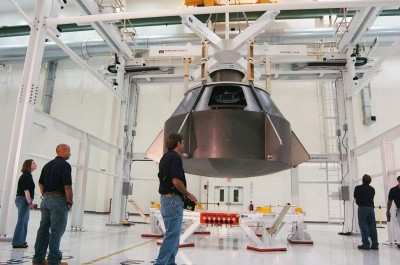
The spacecraft will undergo rigorous testing in Denver to
validate Orion's ability to endure the harsh environments of deep
space. The Orion crew exploration vehicle is on schedule to conduct
its first orbital flight test as early as 2013 and provide initial
operational flights by 2016 as required by the NASA Authorization
Act of 2010.
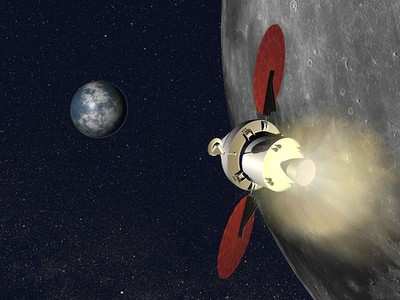
"Our nation's next bold step in exploration could begin by
2016," said John Karas, vice president and general manager for
Lockheed Martin's Human Space Flight programs. "Orion was designed
from inception to fly multiple, deep-space missions. The spacecraft
is an incredibly robust, technically advanced vehicle capable of
safely transporting humans to asteroids, Lagrange Points and other
deep space destinations that will put us on an affordable and
sustainable path to Mars."

The SOSC represents part of Lockheed Martin's multi-million
dollar investment in testing and validating future human
spaceflight programs to ensure safe, affordable and sustainable
space exploration. Today's demonstrations at the SOSC featured
simulated missions to an asteroid and the International Space
Station using laser and optically guided robotic navigation
systems. This system and other cutting edge capabilities
demonstrate how Lockheed Martin employs full-scale motion to test
and verify multiple mission scenarios.
The SOSC currently supports integrated testing of Orion's
Relative Navigation System, which includes STORRM (Sensor Test for
Orion RelNav Risk Mitigation) -- a new and innovative navigation
and docking system that will be tested on the upcoming STS-134
shuttle mission to the International Space Station. STORRM is one
of the major subsystem tests that will be completed before Orion's
first orbital flight test in 2013, that will conduct high-altitude
orbits and a high-energy reentry that simulate the environments of
a deep space mission.
SOSC operations support critical development, evaluation and
testing necessary to ensure safe, successful human and robotic
missions to Earth-orbiting platforms, planets, moons or other
bodies in our solar system. In addition, the center tests ranging,
rendezvous, docking, proximity operations, imaging, descent and
landing systems.
"Lockheed Martin built this remarkable facility to develop and
test spacecraft systems, further demonstrating our commitment to
improve safety and advance capabilities for future U.S. human
spaceflight," said Karas. "Our collective expertise in systems
integration, planetary exploration and human spaceflight operations
will help ensure success for our nation's next generation space
transportation system."
The SOSC is built upon a 1,700-foot-deep Colorado bedrock
formation and is isolated from local seismic disturbances. This
foundation provides an ultra-stable environment for testing
precision instruments and accurate navigation systems needed for
space vehicles. The 41,000-square-foot facility also holds a
Leadership in Energy and Environment Design (LEED) Gold rating for
its high efficiency environmental controls, energy-saving lighting
systems, and native vegetation landscaping.



 ANN's Daily Aero-Term (12.19.25): Ultrahigh Frequency (UHF)


 See All